
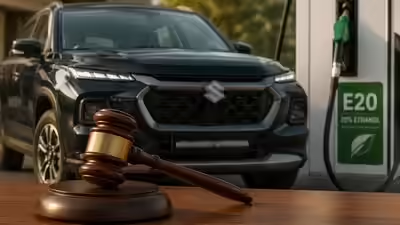
In a landmark ruling that could have far-reaching implications for India’s transition to ethanol-blended fuel, a consumer court in Raipur has directed Maruti Suzuki India and its dealer to replace a customer’s Grand Vitara Strong Hybrid with an E20-compatible model or refund the vehicle cost along with compensation. The case is being seen as the country’s first major consumer court verdict linked to alleged damage caused by E20 petrol.

The dispute was filed by Raipur resident Dr Premraj Devta, who alleged that his Grand Vitara Strong Hybrid Zeta Plus began developing recurring engine problems after being fuelled with E20 petrol. According to the complaint, the vehicle suffered repeated stalling, engine misfiring, declining mileage and a noticeable drop in performance despite multiple visits to authorised service centres and several repair attempts.

After hearing both sides, the Raipur District Consumer Disputes Redressal Commission ruled in favour of the customer and ordered Maruti Suzuki to provide a new E20-compatible vehicle of the same model within 45 days. If the company fails to do so, it will have to refund more than Rs 20.50 lakh, including the vehicle price, RTO charges and insurance premium. The Commission also awarded Rs 1 lakh as compensation for mental harassment and Rs 10,000 towards litigation expenses.
Maruti Suzuki reportedly argued that the Grand Vitara model was already compatible with E20 fuel and denied that ethanol-blended petrol was responsible for the engine issues, attributing the problems to other possible factors. However, the Commission observed that the customer had repeatedly approached authorised workshops without obtaining a permanent solution to the defects.
A key factor in the ruling was the Commission’s observation that motorists today have little choice but to use E20 fuel, as it has become widely available at petrol pumps across the country as part of the government’s ethanol blending programme. Consumers, the court noted, cannot be expected to avoid purchasing the fuel that is being actively promoted and supplied nationwide.
The verdict has intensified the debate over India’s rapid shift towards E20 petrol and whether automobile manufacturers should ensure complete compatibility before selling vehicles in a market where ethanol-blended fuel is increasingly becoming the norm. While the government maintains that E20 fuel does not damage engines and only causes a marginal reduction in fuel efficiency, the ruling could encourage more consumers facing similar issues to seek legal remedies.
👉 Click here to read the latest Gujarat news on TheLiveAhmedabad.com