
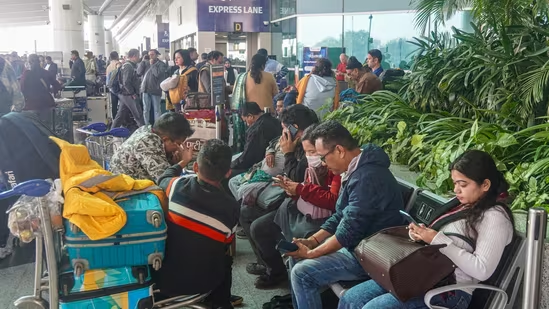
As if winter fog was not disruptive enough, air travellers are set to face fresh challenges from January 21 with the closure of Delhi airspace in view of Republic Day security arrangements.

On Tuesday, the government issued a NOTAM (Notice to Airmen) announcing the suspension of flight operations between 10:20 am and 12:45 pm for six days starting January 21. The two-hour-and-25-minute daily closure, required for practice sessions, the dress rehearsal and the Republic Day parade, is expected to disrupt hundreds of flights, leading to delays, rescheduling and cancellations.

The timing of the NOTAM — issued with just eight days’ notice — has left airlines scrambling to adjust schedules, reroute aircraft and manage misconnected passengers. Industry executives say this could prove to be an expensive and logistically complex exercise, especially during one of the busiest travel periods at Delhi airport.
According to data shared by aviation analytics firm Cirium, more than 600 flights are likely to be impacted during the closure window. This period typically sees heavy inbound traffic from across the country feeding into the afternoon departure bank for Europe and other international and domestic destinations. As a result, thousands of passengers could face disruptions every day.
Authorities mandate such complete airspace closures to ensure security during the Republic Day celebrations, which include a flypast and the movement of dignitaries along Kartavya Path. While not all affected flights may be cancelled, most will see changes in departure or arrival timings. Airlines may also accommodate passengers on alternate flights.
The situation could worsen on days when dense fog reduces visibility, compressing flight operations into an even narrower window. With Delhi airport already operating near full capacity, managing a surge of flights before and after the closure could prove chaotic.
Passengers travelling to or from Delhi during the notified dates and times are advised to ensure their contact details are updated so airlines can communicate schedule changes promptly. In case of cancellations, carriers usually offer rebooking or a full refund. However, given the short notice, airfares on alternate flights are expected to be higher, making re-accommodation a more practical choice for many travellers.
Airlines can act only after receiving formal NOTAM clearance, triggering a chain of last-minute operational decisions, including issuing IRROPS (irregular operations) messages and coordinating with multiple airports. Retiming flights is particularly challenging as other major hubs, including Mumbai, are also operating at full capacity.
The impact of the closure will not be limited to Delhi alone. Aircraft rotations mean that disruptions will cascade to other airports as well, affecting passengers whose journeys neither begin nor end in the capital.
The episode has once again raised questions over the timing of such announcements. As the government positions Delhi as a major passenger transfer hub, relatively short-notice airspace closures risk eroding traveller confidence. While security requirements are non-negotiable, aviation experts argue that advance notice could be issued much earlier — especially for an annual event like Republic Day, held on a fixed date every year — allowing airlines and passengers to plan better.
👉 Click here to read the latest Gujarat news on TheLiveAhmedabad.com