
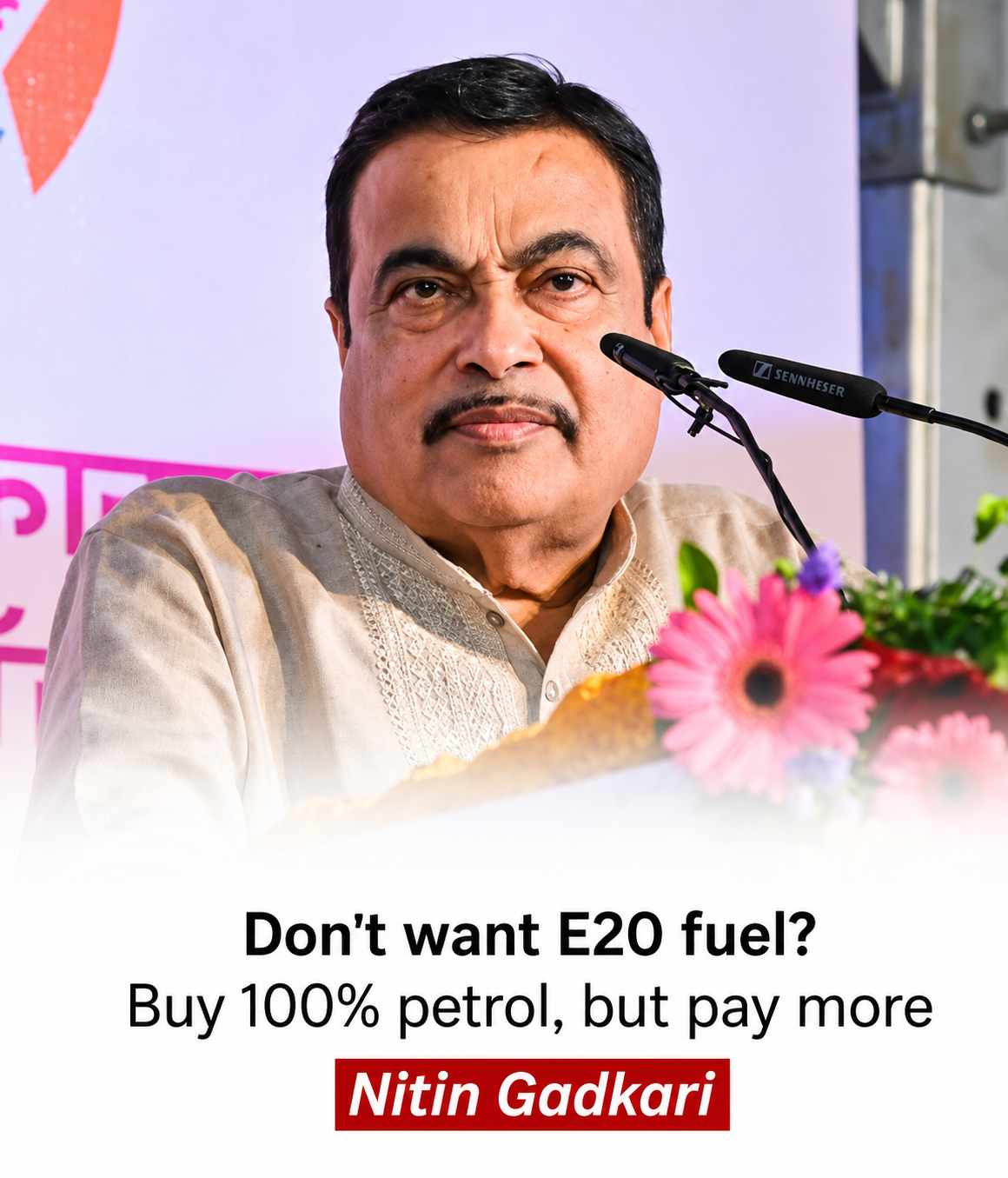
Union Minister for Road Transport and Highways Nitin Gadkari has said motorists who prefer not to use ethanol-blended petrol may have the option of purchasing 100 percent petrol in the future, though it would likely come at a higher price than blended fuel.

The remarks come at a time when the government’s ethanol blending programme is facing growing scrutiny from sections of vehicle owners, automobile enthusiasts and experts, who have raised concerns over fuel efficiency, compatibility with older vehicles and long-term engine performance.

Speaking in an interview, Gadkari rejected claims that E20 fuel — which contains 20 percent ethanol and 80 percent petrol — causes damage to vehicle engines. He said the government had not received complaints regarding engine failures or damage linked to the fuel since its nationwide rollout. The minister said consumers who prefer conventional petrol without ethanol blending could be offered that choice, but added that pure petrol would be more expensive than blended variants due to the economics of fuel production and supply.
India achieved its target of 20 percent ethanol blending ahead of schedule and E20 petrol is now available across fuel stations nationwide. The Centre has promoted ethanol blending as part of its strategy to reduce dependence on imported crude oil, lower emissions and create additional income opportunities for farmers through increased demand for sugarcane and other feedstock used in ethanol production.
While defending the programme, Gadkari acknowledged that ethanol’s lower calorific value compared with petrol can lead to a marginal reduction in fuel economy in some situations. However, he maintained that the impact on mileage is limited and does not pose a risk to vehicle safety or engine durability.
The debate over ethanol-blended fuel has intensified in recent weeks, with some motorists reporting lower mileage and expressing concerns about the suitability of E20 fuel for older vehicles not originally designed for higher ethanol content. Questions have also been raised over the availability of fuel choices for consumers.
The government and automobile manufacturers have defended the policy, stating that ethanol-blended petrol has undergone extensive testing and that newer vehicles sold in India are designed to operate with E20 fuel. The Ministry of Petroleum and Natural Gas recently issued a detailed clarification addressing concerns related to mileage, engine performance and pricing.
The issue has also triggered political debate and public discussion on social media, reflecting the wider implications of India’s transition towards alternative and cleaner transport fuels.
👉 Click here to read the latest Gujarat news on TheLiveAhmedabad.com