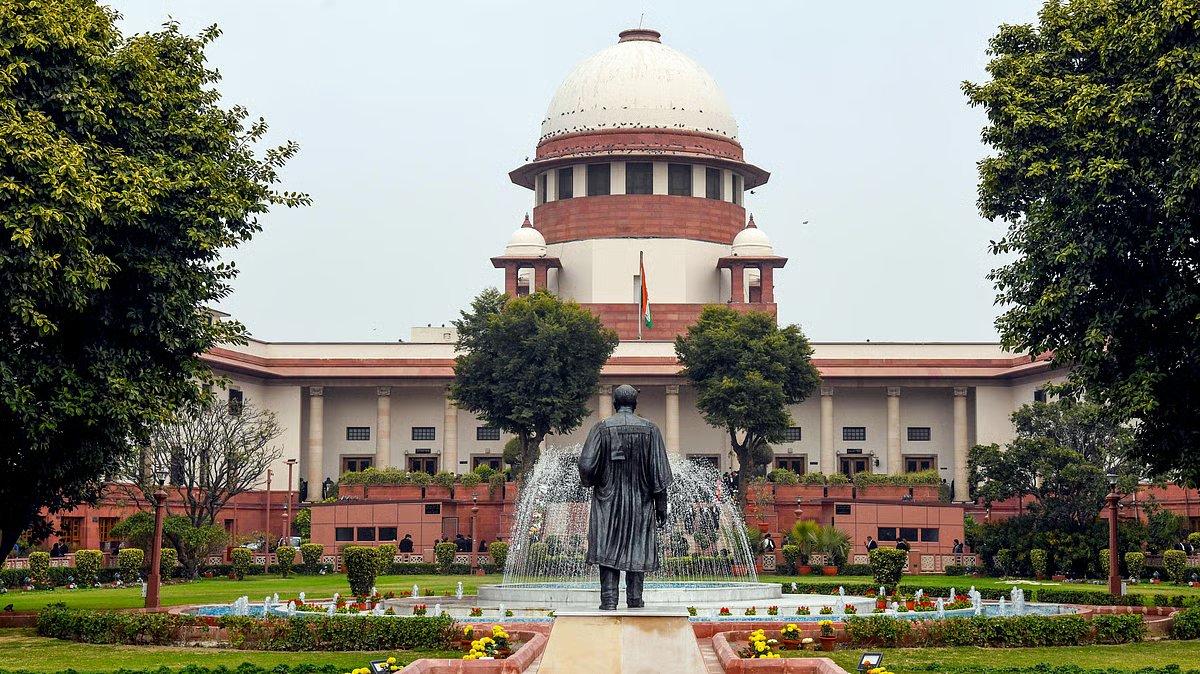
The Supreme Court on Tuesday sought the response of the Central Board of Secondary Education (CBSE) on petitions challenging the implementation of its revised three-language policy, while assuring teachers that they would receive legal protection if any punitive action was initiated against them for non-compliance.

A Bench comprising Chief Justice of India Surya Kant and Justices Joymalya Bagchi and V Mohana heard a batch of petitions questioning the rollout of the policy for students of Classes VI to IX under the National Education Policy (NEP) 2020 framework. During the hearing, petitioners raised concerns over the lack of textbooks, shortage of qualified teachers and the difficulties faced by schools in introducing additional language requirements during the ongoing academic session. Addressing apprehensions that teachers could face disciplinary action for failing to teach newly introduced languages due to inadequate resources, the Chief Justice assured that the court would intervene if such situations arose.

The court subsequently issued notice to the CBSE and directed it to file its response to the petitions. Representing the Centre, Additional Solicitor General Aishwarya Bhati informed the Bench that the Board would submit its reply within two weeks. The matter has been scheduled for further hearing on July 22.
During the proceedings, counsel appearing for the petitioners argued that schools across the country were struggling to implement the policy because the required infrastructure and academic resources were not yet available. Senior Advocate Gopal Sankaranarayanan told the court that textbooks were currently available for only a handful of the 22 recognised Indian languages, making implementation impractical for many institutions. He also highlighted the shortage of teachers capable of teaching additional languages.
Senior Advocate Mukul Rohatgi questioned the feasibility of introducing a new language requirement at short notice, particularly for students already studying foreign languages as part of their curriculum. Another petitioner argued that the revised framework imposed additional academic obligations without providing schools and students sufficient time or resources to adapt to the changes.
During the hearing, Justice Joymalya Bagchi observed that the objective of the policy was to promote Indian languages in accordance with constitutional principles and the broader goals of the National Education Policy. However, he noted that certain aspects of the terminology used in the policy may require further examination.
The petitions challenge a CBSE circular issued on May 15, which aligns the Board’s curriculum with the National Education Policy 2020 and the National Curriculum Framework for School Education (NCFSE) 2023. Under the revised guidelines, students in Classes VI to IX from the 2026-27 academic session are required to study three languages, with at least two of them being Indian languages.
Parents, teachers and education groups from various parts of the country have opposed the move, arguing that the policy places additional pressure on students and schools due to the lack of trained teachers, textbooks, clarity regarding assessments and the challenges associated with implementing the changes during an ongoing academic year.
👉 Click here to read the latest Gujarat news on TheLiveAhmedabad.com