
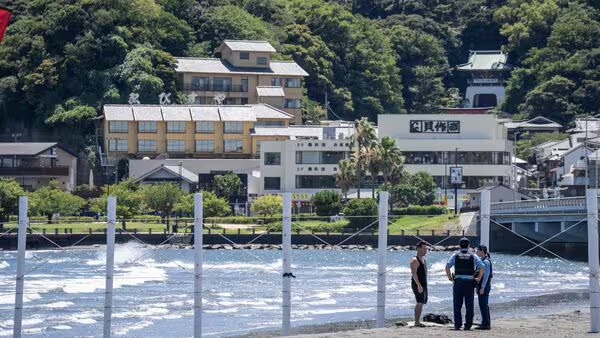
One of the most powerful earthquakes in recent memory jolted Russia’s Far East on Wednesday, setting off tsunami warnings across the Pacific and unleashing a flood of dramatic footage on social media. The magnitude 8.8 tremor struck offshore near the Kamchatka Peninsula, rattling towns, shaking homes, and prompting mass evacuations in vulnerable coastal areas.

Tsunami warnings were issued across the Pacific, including Hawaii, Japan, and the U.S. West Coast
Scary, Videos showing the shaking from the M8.7 earthquake that hit off the coast of Kamchatka, Russia #earthquake #tsunami #Russia #Japan #Hawaii #Alaska pic.twitter.com/dAZY8dpsIF— Sumit (@SumitHansd) July 30, 2025

Seismic Shock Near a Tectonic Hotspot
The earthquake’s epicenter was located roughly 136 kilometers southeast of Petropavlovsk-Kamchatsky, at a depth of around 20 kilometers beneath the ocean floor. According to seismologists, the quake occurred along the Kuril-Kamchatka Trench — a major subduction zone where the Pacific Plate is thrusting beneath the Okhotsk Sea Plate, part of the North American tectonic system in this region.
Experts identified the event as a “megathrust earthquake,” caused by shallow reverse faulting — a violent geological process in which one section of Earth’s crust is suddenly forced over another. The rupture zone extended nearly 390 kilometers in length and 140 kilometers in width, consistent with patterns observed in previous large-scale subduction events.
A Sequence of Tremors Raises Alarms
The massive quake was preceded by a magnitude 7.4 foreshock on July 20, and followed by at least 14 significant aftershocks, including a magnitude 6.9 tremor. Notably, the location of Wednesday’s quake lies close to the epicenter of the 1952 Kamchatka earthquake, a catastrophic event that registered at magnitude 9.0 and generated a devastating tsunami.
Tsunami Alerts Spread Across the Pacific Rim
Tsunami warnings were swiftly issued across the Pacific Basin, including Russia, Japan, Alaska, Hawaii, Guam, and several other Pacific territories. In Kamchatka, waves up to 4 meters were reported, prompting evacuations in towns such as Severo-Kurilsk. Japan’s Meteorological Agency also sounded the alarm, forecasting waves up to 3 meters.
In the United States, authorities placed segments of the West Coast on tsunami watch, although the threat level there remained comparatively moderate. Nevertheless, the quake served as a stark reminder of the Pacific Ring of Fire’s persistent seismic volatility.
Internet Reacts to Terrifying Scenes
Within minutes of the tremor, social media platforms were inundated with chilling footage — swaying buildings, damaged interiors, receding waters, and sirens echoing across towns. One widely shared post read, “Tsunami warnings in Hawaii, Japan, U.S. West Coast after the M8.8 quake off Kamchatka. Frightening scenes everywhere.”
Outlook and Ongoing Monitoring
While geologists suggest the probability of another large quake in the immediate aftermath is low due to pressure redistribution, authorities remain cautious. The region continues to be monitored closely, with residents urged to stay alert.
Kamchatka’s seismic jolt stands as a sobering testament to the immense geological forces shaping Earth’s crust — and a vivid reminder of the need for readiness in tectonically active regions.
Ask ChatGPT
👉 Click here to read the latest Gujarat news on TheLiveAhmedabad.com