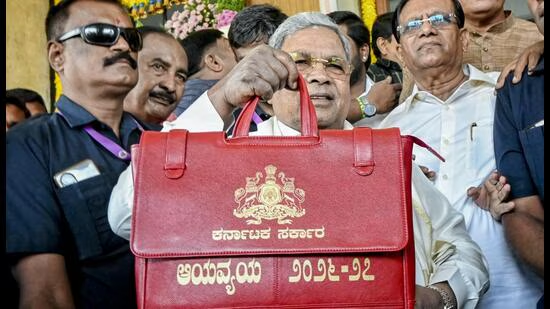
Karnataka Chief Minister Siddaramaiah on Friday highlighted the growing concerns over excessive mobile phone usage among children and announced that social media access for those under the age of 16 will be banned in the state. The announcement was made while presenting the ₹4.48 lakh crore state budget for the financial year 2026–27, which includes a mix of technology-driven learning initiatives and regulatory measures aimed at protecting children online.

Once implemented, Karnataka will become the first state in India to introduce restrictions on social media usage for children. The move comes amid growing global concerns about the impact of social media on mental health, sleep patterns, and online safety among young users. In December, Australia banned social media access for individuals under the age of 16. Several European countries have already adopted or are considering similar restrictions, while Britain recently sought feedback from parents and children on banning social media for under-16s and introducing regulations for gaming platforms and artificial intelligence.

“To prevent adverse effects of increasing mobile usage on children, usage of social media will be banned for children under the age of 16,” said Siddaramaiah.
The Chief Minister also proposed introducing an Artificial Intelligence-based learning system for students in the state. According to the proposal, the government will launch a personalised digital tutoring platform developed in collaboration with the Indian Institute of Technology (IIT) Dharwad. The system is expected to support students from Classes 8 to 12 and benefit approximately 1.22 million students, with an estimated implementation cost of ₹5 crore.
In the higher education sector, the state government plans to strengthen institutions and address faculty shortages. The University of Visvesvaraya College of Engineering in Bengaluru will receive ₹500 crore for development along the lines of the Indian Institutes of Technology, with ₹100 crore allocated in the current financial year. The government has also authorised the recruitment of 2,000 teaching staff for degree colleges, polytechnics, and engineering colleges across the state.
Siddaramaiah further announced the introduction of the Rohith Vemula Bill, which aims to address caste-based discrimination in higher education institutions.
The budget also includes several measures aimed at strengthening the school education system. The government plans to invest ₹3,900 crore over the next three years to expand the Karnataka Public Schools system from lower kindergarten to Class 12, increasing the number of such schools to 800. Additionally, 15,000 teachers will be recruited for primary and high schools. For the first time, female guest lecturers in government colleges will be eligible for 90 days of maternity leave.
According to the budget estimates, the state expects a revenue deficit of ₹22,957 crore. This marks the third consecutive year in which the budget projects a revenue deficit.
During the presentation, Siddaramaiah also introduced what he described as the “11G Economic Model,” aimed at balancing economic growth with social welfare. The framework will focus on areas such as public education, healthcare, grassroots economic development, governance reforms, support for the gig economy, geographical equality, global trade integration, the global protein economy, environmental sustainability, and urban expansion.
Siddaramaiah said Karnataka’s economy continues to grow faster than the national average. He noted that the state recorded a Gross State Domestic Product (GSDP) growth rate of 8.1% in 2025–26 compared to the national growth rate of 7.4%. He also pointed out that changes in the Union government’s tax policies had affected the state’s finances. The state collected ₹1.32 lakh crore in Goods and Services Tax (GST) in the previous year, but GST rationalisation reduced Karnataka’s share of the revenue.
In the healthcare sector, the Chief Minister announced home-based palliative care services for patients suffering from severe, chronic, and terminal illnesses. The programme will be implemented in collaboration with Pallium India.
He also announced the expansion of Bengaluru’s metro network, with around 41 km of new lines expected to be added within the next year. The expansion is projected to benefit nearly 1.5 million commuters.
👉 Click here to read the latest Gujarat news on TheLiveAhmedabad.com