
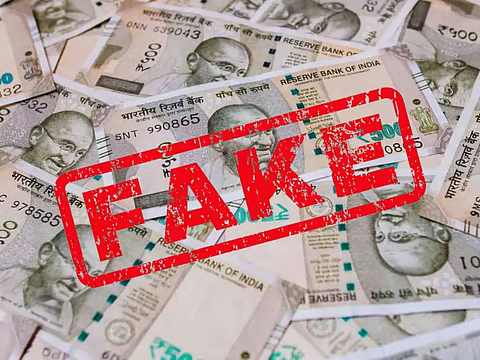
India’s security agencies have flagged a rise in the number of entry points being used to circulate fake currency across the country. Earlier, counterfeit notes were routed from Pakistan into Nepal before entering India. However, with tighter surveillance along the Nepal border, operations shifted to Malda in West Bengal.

The National Investigation Agency (NIA), which is probing several such cases, found that Malda housed sophisticated printing units. Materials were allegedly sourced from Pakistan via the Bangladesh border, after which fake notes were printed locally and circulated.

An official from the Intelligence Bureau said the racket has now expanded to more regions, with Murshidabad and Nadia in West Bengal emerging as new hotspots. Other key areas where the network is active include Coastal Andhra, Tamil Nadu, Kerala, Gujarat, Delhi and Maharashtra.
Officials added that apart from West Bengal being a major source, fake currency is also being routed through Dubai before entering southern states.
Another official said the network continues to be controlled by the syndicate of Dawood Ibrahim, allegedly under instructions from Inter-Services Intelligence (ISI) to scale up production and expand operations nationwide. This, officials said, explains the increasing number of fake currency rackets being busted across India.
The network is also increasingly using social media to conduct operations. In Malkapur in Maharashtra, deals involving fake currency were reportedly struck online. Cities like Pune and Bhiwandi have also emerged as key centres for such activities.
Officials said the syndicate is leveraging technology, including Artificial Intelligence (AI), to improve the quality of counterfeit notes and evade detection. AI tools are reportedly being used to gather inputs on printing techniques and methods to avoid law enforcement.
Most of the printing material continues to be sourced from Pakistan, with the Pakistan Security Printing Corporation (PSPC) identified as a primary supplier. More recently, Chinese-origin paper is also being used, adding to the challenges faced by agencies.
Officials said the printing and circulation of fake currency is part of a broader ISI strategy to undermine India’s economy. There are indications that the network may be attempting to establish printing capabilities across multiple states.
Distribution routes have also diversified. In addition to West Bengal, West Godavari and East Godavari in Andhra Pradesh have emerged as key hubs for circulation in southern states.
The syndicate appears to be adopting a region-specific approach, creating separate networks for different areas. This reduces transportation distances and lowers the risk of detection. Officials added that limited interaction between regional units is a deliberate strategy to minimise exposure and avoid crackdown by law enforcement agencies.
👉 Click here to read the latest Gujarat news on TheLiveAhmedabad.com