
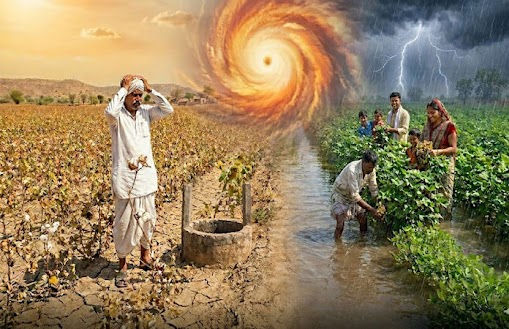
A new forecast by the European Union’s Copernicus Climate Change Service (C3S) has raised concerns over India’s monsoon outlook, with global climate models indicating the possibility of below-normal rainfall across large parts of the country during the July-September period.

The assessment suggests that western and central India could face the greatest impact if El Niño conditions in the Pacific Ocean continue to strengthen in the coming months.

Among the states likely to be affected, Gujarat could see a substantial rainfall deficit, while parts of Maharashtra, including the Konkan region, and Goa may receive between 100 mm and 200 mm less rainfall than usual.
The projections have sparked concerns over their potential impact on agriculture, water resources and the broader economy, given the crucial role of the southwest monsoon in supporting India’s farm sector and replenishing reservoirs.
Meteorologists are closely tracking the evolving El Niño conditions. The climate phenomenon is characterised by unusually warm sea-surface temperatures in the central and eastern Pacific Ocean and is often associated with weaker monsoon activity over the Indian subcontinent.
Scientists use the term “Godzilla El Niño” to describe particularly intense El Niño events capable of significantly disrupting weather patterns across the globe.
Preliminary observations for June 2026 indicate that warming in the Pacific is intensifying, a development that could alter atmospheric circulation and weaken moisture-laden monsoon winds reaching India.
The India Meteorological Department (IMD) has already forecast seasonal rainfall during the June-September monsoon period at around 90-92 per cent of the long-period average, placing it in the below-normal category.
Experts warned that deficient rainfall could adversely affect kharif crops such as paddy, cotton, pulses, soybean and oilseeds, all of which rely heavily on monsoon rains. Reduced rainfall may impact crop yields, push up production costs and contribute to higher food inflation, they said.
Concerns have also been raised about reservoir and dam storage levels. A prolonged rainfall deficit could affect irrigation supplies in rural areas and increase pressure on drinking water resources in urban centres.
However, climate experts cautioned that long-range seasonal forecasts remain subject to change and should not be viewed as definitive predictions. They noted that rainfall distribution is unlikely to be uniform, with some eastern and northern regions expected to perform better than western and central India.
Meteorologists have advised governments and farmers to strengthen water conservation efforts, improve irrigation planning and promote drought-resilient crops in preparation for possible rainfall shortages.
Beyond India, a strong El Niño event could influence weather conditions across several regions of the world. Australia, Indonesia and parts of Southeast Asia may experience drier-than-normal conditions, while some parts of South America could see excessive rainfall and flooding.
Climate researchers also warned that disruptions to agricultural output in key producing regions may affect global supplies of commodities such as coffee, sugar, cocoa and palm oil.
India has historically experienced weaker monsoon seasons during strong El Niño years, making the evolving Pacific Ocean weather system a critical factor being closely monitored by meteorological agencies and policymakers ahead of the peak monsoon months.
👉 Click here to read the latest Gujarat news on TheLiveAhmedabad.com