
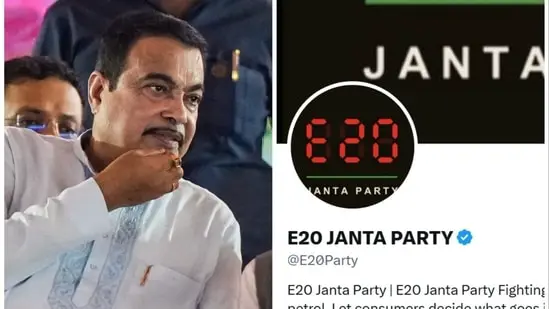
Even as the buzz around the Cockroach Janta Party (CJP) is yet to subside, another satirical social media campaign—the E20 Janta Party—has begun gaining traction online. The movement appears to target Union Transport Minister Nitin Gadkari’s push for E20 ethanol-blended petrol, a policy that has received mixed reactions across the country.

The youth-led CJP protest at Delhi’s Jantar Mantar recently dominated national headlines. Started by Boston University graduate Abhijeet Dipke, the satirical movement evolved into a mass protest over alleged exam irregularities and ultimately culminated in the resignation of Union Education Minister Dharmendra Pradhan.

With the CJP agitation ending, the spotlight has now shifted to the E20 Janta Party. Although its founder remains unknown, its social media pages have rapidly gained followers.
E20 fuel is a blend of 20 per cent ethanol and 80 per cent petrol, promoted to reduce crude oil imports, lower vehicle emissions and support farmers. Critics, however, argue that it may damage older vehicles, reduce fuel efficiency and increase water consumption for ethanol-producing crops.
E20 Janta Party gains momentum online
An X account named E20 Janta Party dates back to May 2024, suggesting it previously operated under a different name before being rebranded to capitalise on the current trend of using satire to raise public issues.
The account reportedly began attracting attention over the weekend, gaining more than 25,000 followers within hours on Sunday and crossing 48,000 followers by Monday morning. Its Instagram page also surpassed 100,000 followers on Sunday. Amid its growing popularity, the outfit clarified that it is not demanding subsidies, free fuel or the withdrawal of E20 petrol, but only wants consumers to have the freedom to choose the fuel they wish to purchase.
In one of its posts, the outfit said it is not a political party but an independent citizens’ movement focused on transparency, consumer rights and encouraging public discussion on the impact of India’s E20 fuel policy. It also said it does not support or endorse any political party and urged people not to be distracted by speculation about who is behind the movement. According to the group, its demand is simple: accountability, transparency and the right of consumers to be heard. Another post called for the resignation of Union Minister Nitin Gadkari.
A separate account with the same name, followed by around 28,000 users, announced a Parliament March on August 4, claiming that taxi operators, tourist vehicle owners and commercial transport operators from across the country would protest against E20 petrol and the mandatory installation of GPS and panic button systems in vehicles.
According to the account, the march will be led by Sanjay Samrat, with thousands of drivers and vehicle owners expected to participate. However, it remains to be seen whether the proposed protest will generate public support comparable to that received by the CJP movement.
Cockroach Janta Party’s rise
The CJP emerged as a viral online movement in May after remarks attributed to Chief Justice of India Surya Kant allegedly compared certain unemployed youth and social media activists to “cockroaches” and “parasites” during a court hearing.
Turning the remarks into a symbol of protest, Abhijeet Dipke launched the CJP website and social media pages a day after the comments surfaced. Within days, the movement attracted millions of followers on Instagram, surpassing even the Bharatiya Janata Party’s follower count on the platform.
Dipke later returned to India and organised demonstrations across several cities before launching an indefinite sit-in at Jantar Mantar on June 20, demanding Dharmendra Pradhan’s resignation over recurring examination irregularities. The agitation intensified after activist Sonam Wangchuk was allegedly removed from the protest site and admitted to Safdarjung Hospital following a deterioration in his health.
On July 20, as Parliament’s Monsoon Session began, large crowds gathered at Jantar Mantar and nearby areas in response to the CJP’s call for a march to Parliament.
After six days of sustained protests and intermittent tensions with security personnel, the agitation concluded on July 25 following the announcement of Dharmendra Pradhan’s resignation as Union Education Minister.
👉 Click here to read the latest Gujarat news on TheLiveAhmedabad.com