
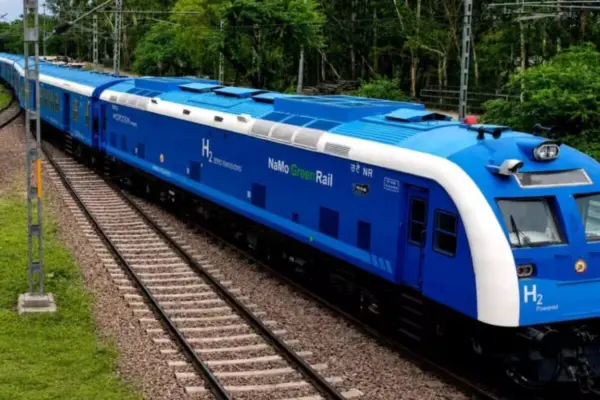
India has taken a major step towards sustainable transportation with the launch of its first hydrogen-powered passenger train, marking the country’s entry into the emerging global network of hydrogen rail systems.

Prime Minister Narendra Modi flagged off the train from Jind railway station in Haryana on Friday, introducing a service that combines green technology with one of the lowest fares in the Indian Railways system. The train will operate on the Northern Railway’s Jind-Sonipat route and has been developed using indigenous hydrogen fuel cell technology as part of India’s efforts to promote clean mobility and reduce reliance on fossil fuels.

Fares Start at Rs 5
The newly launched service has attracted attention not only for its technology but also for its affordability. Ticket prices begin at just Rs 5 and go up to Rs 25 depending on the distance travelled.
The minimum fare is lower than the cost of a platform ticket at several railway stations, making the service accessible to daily commuters and short-distance passengers.
Route and Operations
The hydrogen-powered train will run between Jind Junction and Sonipat, covering a distance of nearly 90 kilometres in about two hours.
The service has been approved to operate at a maximum speed of 75 kmph, while the train has a design speed of 110 kmph. The train will halt at Jind City, Pandu Pindara, Lalit Khera Halt, Bhambhewa, Isapur Kheri Halt, Butana Halt, Khandrai Halt, Rabrah Halt, Lath, Mohana and Barwasni Halt before reaching Sonipat.
Capacity and Configuration
The train consists of 10 coaches and can accommodate around 2,600 passengers.
The rake includes two hydrogen-powered driving power cars and eight trailer coaches powered by a 1,200 kW hydrogen fuel cell propulsion system.
How Hydrogen Technology Works
Unlike diesel trains or electric trains that rely on overhead power lines, the new service generates electricity onboard through hydrogen fuel cells.
The technology uses hydrogen and oxygen to produce electricity, with water vapour and heat being the only by-products, making the train virtually emission-free. Hydrogen required for operations will be supplied through a dedicated production and refuelling facility established at Jind.
Safety Features
The train has been equipped with advanced monitoring systems capable of detecting hydrogen leaks, smoke, fire and overheating to ensure safe operations.
Officials said the hydrogen infrastructure and train systems have undergone extensive safety testing and independent assessments before passenger operations commenced.
India’s Largest Hydrogen Rail Facility
The project has also led to the establishment of the country’s largest railway hydrogen storage and refuelling facility at Jind.
According to officials, the facility can store nearly 3,000 kg of hydrogen and has been developed in accordance with international safety standards.
India Joins Select Group of Nations
With the launch of the service, India joins a small group of countries that have adopted hydrogen-powered passenger trains as part of their public transport systems.
Countries such as Germany, France, the United Kingdom, Italy, Japan, China and the United States have already introduced or tested hydrogen rail technology.
Major Push for Green Mobility
Haryana Chief Minister Nayab Singh Saini described the launch as an important milestone in India’s clean energy transition and said the project reflects the country’s focus on self-reliance and sustainable development.
Along with flagging off the hydrogen train, Prime Minister Modi also inaugurated the redeveloped Jalandhar Cantonment railway station under the Amrit Bharat Station Scheme and dedicated 75 upgraded railway stations across the country through virtual mode. The Prime Minister also flagged off the Sant Ravidas Express between Amritsar and Varanasi and inaugurated new healthcare infrastructure at PGIMER in Chandigarh.
The launch of the hydrogen train is being seen as a significant milestone for Indian Railways as it combines indigenous technology, zero-emission operations and low-cost travel, bringing environmentally friendly transport within the reach of ordinary passengers.
👉 Click here to read the latest Gujarat news on TheLiveAhmedabad.com