
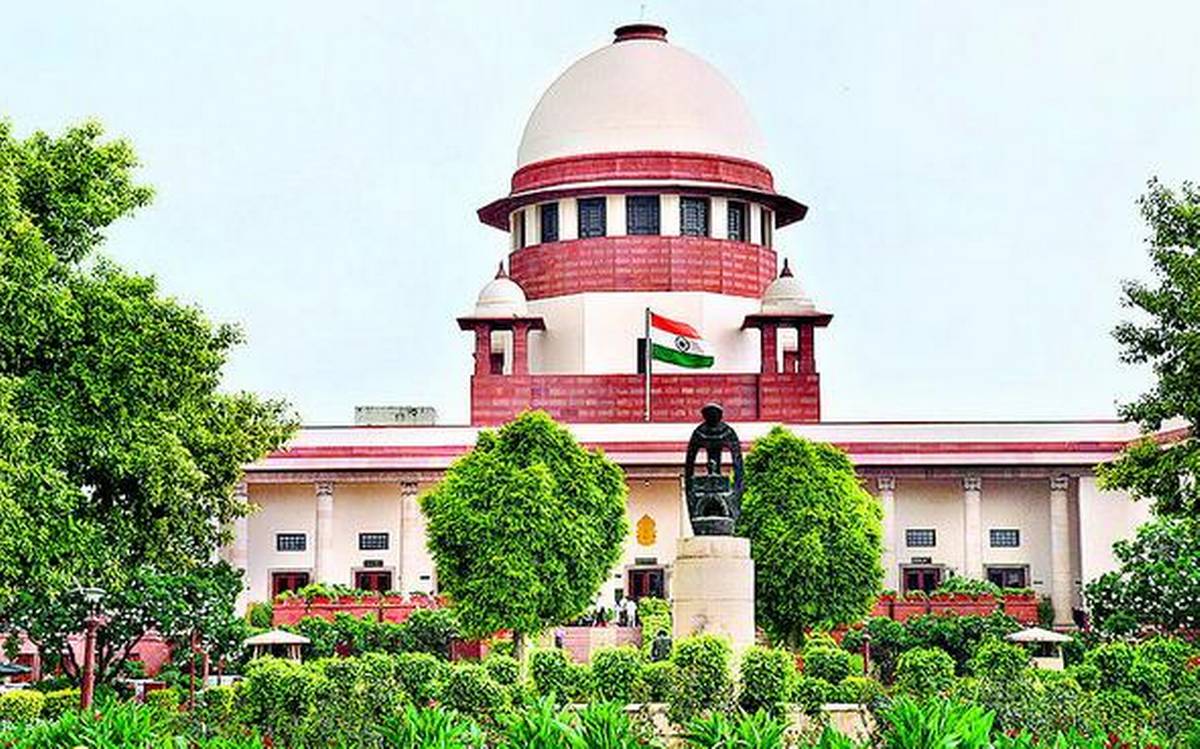
The Supreme Court has held that employees and their families are entitled to compensation under the Employees’ Compensation Act, 1923, not only for accidents during work but also for mishaps while commuting to and from their workplace.

In a key ruling expanding workers’ rights and social welfare coverage, a bench of Justices Manoj Misra and KV Viswanathan interpreted the phrase “accident arising out of and in the course of employment” in Section 3 of the EC Act to cover commuting accidents, as long as there is a clear link between the time, place, and circumstances of the accident and the employment.

Authored by Justice Viswanathan, this liberal interpretation was delivered in a case concerning the death of a sugar factory watchman on his way to work. It marks a progressive step in widening the social security net for millions of workers across India, particularly those outside the coverage of the Employees’ State Insurance (ESI) scheme.
“We interpret the phrase ‘accident arising out of and in the course of employment’ under Section 3 of the EC Act to include accident occurring to an employee while commuting from his residence to the place of employment for duty or from the place of employment to his residence after performing duty,” the court stated in its July 28 ruling.
It clarified that the benefit of this interpretation is contingent on showing a clear nexus between the time, place and circumstances of the accident and the employment. That is, if a worker meets with an accident during a routine and timely commute to or from the workplace, it may qualify as employment-related for compensation purposes.
The judgment came in a case involving Shahu Sampatrao Jadhavar, who worked as a watchman at a sugar factory in Maharashtra. His shift on April 22, 2003, was scheduled from 3 AM to 11 AM. While commuting to work in the early hours, his motorcycle met with a fatal accident around 5 km from the factory. He left behind his widow, four children, and his mother.
A claim under EC Act was allowed by the commissioner for workmen’s compensation and civil judge, Osmanabad, who awarded ?3,26,140 as compensation along with 12% annual interest, and also directed the employer to pay 50% of the amount as penalty. The employer’s insurance company was held liable to pay the compensation.
However, the Bombay High Court reversed the award, holding that since the accident occurred outside the precincts of the factory, it could not be said to have arisen out of employment.
Setting aside the high court’s ruling, the top court restored the commissioner’s award and reaffirmed that the commute to work can form an integral part of employment under EC Act if the contextual nexus is established.
The court drew from Section 51E of ESI Act, which was introduced in 2010 and explicitly provides that commuting accidents, if there is a connection between the circumstances, time and place, are deemed to have occurred in the course of employment.
While EC Act does not have such a specific provision, the top court held that since both statutes are beneficial legislation aimed at social welfare and worker protection, they are “statutes in pari materia” (dealing with the same subject matter). Hence, the interpretation under one can inform the other.
“Both the EC Act and the ESI Act seek to ameliorate the conditions of workmen and provide them social security benefits,” stated the judgment, noting that EC Act applied to all other employers and employees not covered under ESI scheme.
The court referred to its 2016 judgment in Jaya Biswal vs IFFCO Tokio General Insurance Co to reiterate that the EC Act is a social welfare law designed to provide workers with minimum protection and compensation, ensuring reduced legal formalities and applying irrespective of fault.
👉 Click here to read the latest Gujarat news on TheLiveAhmedabad.com