
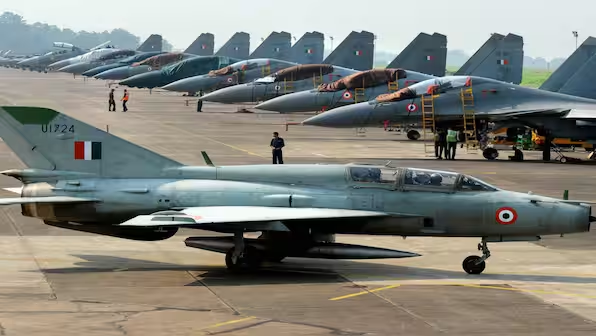
The Indian Air Force (IAF) closed a historic chapter on Friday as the iconic MiG-21 fighter jet was formally retired after serving the nation for more than 60 years. The farewell ceremony was held in Chandigarh, the very city where the aircraft was first inducted in 1963.

Marking the end of an era, the MiG-21 took to the skies one last time, flying in formation with the indigenous Tejas fighter. The display carried a symbolic message: “I hand over the glory to the next lineage.”

Defence Minister Rajnath Singh, paying tribute to the legendary aircraft, described the MiG-21 as more than just a fighter jet — calling it a bridge of trust between India and Russia. Responding to criticism that the IAF was flying “60-year-old planes,” Singh clarified that the current fleet had an operational life of around 40 years, which is the global norm for fighter jets. He also credited Hindustan Aeronautics Limited (HAL) for modernizing the aircraft with advanced avionics and radars to keep it combat-ready for decades.
A Historic Last Flight
The ceremony witnessed six upgraded MiG-21 Bison variants take off for their final sortie, led by Air Chief Marshal A.P. Singh (call sign Badal 3). The formation flight concluded with a water cannon salute, signifying both farewell and respect. Squadron Leader Priya Sharma, one of India’s women fighter pilots, also participated, underlining the aircraft’s role in inspiring new generations.
Backbone of the IAF
Since April 1963, over 1,200 MiG-21s have been inducted, making it the most widely deployed jet in the IAF’s history. At its peak, multiple MiG variants — 21, 23, 25, 27, and 29 — operated simultaneously, earning the force the nickname “MiG Air Force.”
Designed by the Soviet Union as a supersonic interceptor, the MiG-21 evolved into a versatile multirole fighter for India, handling tasks from air defence to ground strikes and reconnaissance.
War Proven Warrior
The MiG-21 played a decisive role in four major operations — the 1965 and 1971 wars with Pakistan, the 1999 Kargil conflict, and the 2019 Balakot strike. Its contribution during the 1971 war was particularly significant. Veteran Squadron Leader S.S. Tyagi credited the aircraft with nearly 80% of India’s success in the conflict, recalling its bombing raids over Dhaka and effective destruction of enemy targets.
The Training Ground of Pilots
For decades, almost every fighter pilot in the IAF trained on a MiG-21 or its upgraded versions. Retired officers described it as both an enigma and a legend, admired for its power and respected for its complexity. The crowds gathered at Chandigarh to witness its farewell reflected this deep emotional connection.
Shadows of a “Flying Coffin”
Despite its illustrious service, the MiG-21 faced criticism for frequent accidents in its later years, earning the grim tag of “flying coffin.” More than 300 crashes were recorded, often attributed to aging airframes. A 2023 crash in Rajasthan’s Hanumangarh district, which killed three civilians, led to temporary grounding of the fleet.
Indo-Russian Legacy
The MiG-21 also stood as a testament to Indo-Russian defence cooperation. Built under licence by HAL, it was continuously upgraded to extend its relevance. Its adaptability and longevity made it one of the longest-serving fighters of its generation anywhere in the world.
Closing a Chapter, Opening Another
For the IAF, retiring the MiG-21 was a moment of pride mixed with nostalgia. Veterans called it both a mentor and a comrade. With its departure, the Air Force now pivots towards newer platforms such as the Tejas, Rafale, Su-30MKI, and upcoming advanced fighters.
Squadron Leader Priya Sharma’s participation in the farewell flight highlighted the transition — from a Soviet-era warhorse to a new era of indigenous air power.
Enduring Legacy
The MiG-21 leaves behind an unmatched record:
- Over 1,200 jets inducted since 1963
- Participation in four wars
- Training ground for generations of pilots
- More than six decades of frontline service
While its nickname “flying coffin” will remain part of its history, the MiG-21 will be remembered above all as India’s first supersonic fighter and the backbone of the Air Force for much of its modern history.
👉 Click here to read the latest Gujarat news on TheLiveAhmedabad.com