
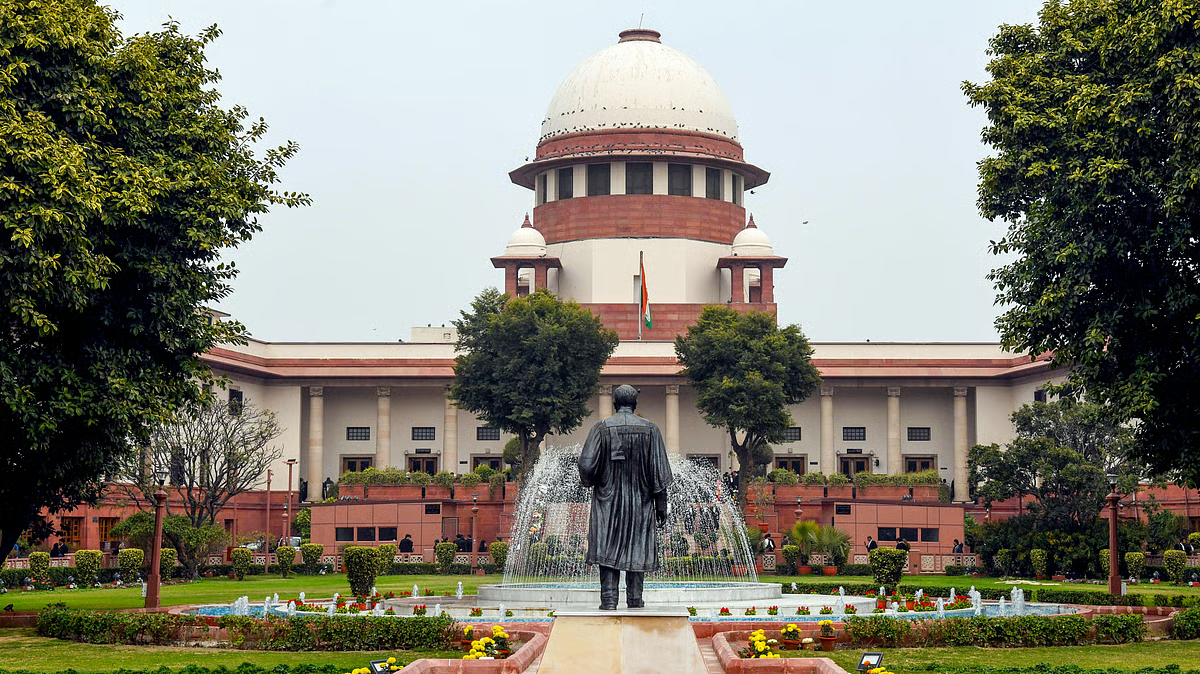
The Supreme Court on Monday directed the Central Board of Secondary Education (CBSE) to implement the Orissa High Court’s ruling on the Automated Permanent Academic Account Registry (APAAR) across the country, ensuring that parental consent for generating APAAR IDs is genuinely voluntary and includes a clear option to opt out.

A Bench comprising Chief Justice of India Surya Kant, Justice Joymalya Bagchi and Justice V Mohan said it would also issue directions to the CBSE to address concerns relating to data privacy, protection of children’s personal information and the voluntary nature of the APAAR scheme.

The order came while hearing a writ petition filed by Abhishek Baxi and others challenging the Aadhaar-linked student identification system. Appearing for the petitioners, senior advocate Indira Jaising argued that although the government describes APAAR as voluntary, it effectively becomes mandatory because it is linked to Aadhaar and is allegedly required for several academic processes, including examinations.
The petitioners also raised concerns over the collection, storage and processing of children’s personal data, questioning whether the scheme complies with the Digital Personal Data Protection Act, 2023. They argued that the Right to Education cannot be made conditional upon obtaining an Aadhaar number or an APAAR ID, and cited the Supreme Court’s 2019 Puttaswamy judgment, which recognised privacy as a fundamental right and held that children cannot be compelled to obtain Aadhaar.
While acknowledging that the objective of creating a unique lifelong academic identifier could help streamline educational records, monitor student progress and improve policy implementation, the Bench stressed that participation in the APAAR programme must remain entirely voluntary.
Chief Justice Surya Kant observed that the concept behind APAAR is beneficial for maintaining a unified academic database but clarified that all CBSE circulars related to the scheme must comply with existing laws, including the Digital Personal Data Protection Act.
The Supreme Court noted that the Orissa High Court, in its December 2025 judgment in Rohit Anand Das & Another vs State of Odisha & Others, had directed the Union Ministry of Education to revise the APAAR consent form after finding that it failed to clearly offer parents the option to refuse participation. The High Court had ruled that the existing form only allowed withdrawal after consent had already been given, which did not adequately reflect the voluntary nature of the scheme. It had also emphasised the need for stronger privacy safeguards for children under Article 21 of the Constitution.
Since the Centre did not challenge the Orissa High Court’s ruling, the Supreme Court directed the CBSE to implement the decision nationwide. “We will direct CBSE to implement this judgment on a pan-India basis. We are directing CBSE to examine the issues as well,” the Chief Justice said.
Launched on July 29, 2023, the APAAR initiative aims to assign every student a unique lifelong digital academic identity linked to Aadhaar for maintaining educational records. However, the petitioners contended that the scheme and related CBSE circulars violate Articles 14, 19, 21 and 21A of the Constitution. They sought safeguards including informed and revocable consent, a meaningful opt-out mechanism and assurance that students who choose not to enrol will not face any adverse consequences such as denial of examinations, certificates or other academic benefits.
👉 Click here to read the latest Gujarat news on TheLiveAhmedabad.com