
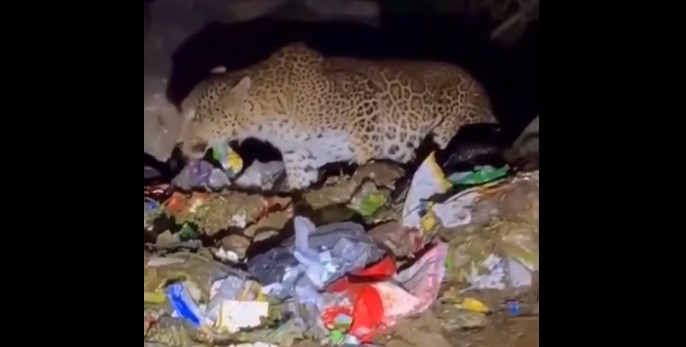
A distressing video circulating on social media has reignited concerns about the growing human encroachment into wildlife habitats. The 17-second clip, shared by Indian Forest Service (IFS) officer Parveen Kaswan, captures a leopard rummaging through a heap of garbage near Mount Abu in Rajasthan — a stark reminder of how urban waste and habitat destruction are forcing wild animals into human-dominated spaces.

What a sad visual. Shri Shivansh Sah recorded this #leopard near Mount Abu.
See how our trash is reaching the wild ! pic.twitter.com/V5YUSOwXiW— Parveen Kaswan, IFS (@ParveenKaswan) October 18, 2025

Leopards, typically known for their stealth, agility, and prowess as apex predators, appear in a pitiable state in the footage — scavenging through plastic and refuse in search of food. Sharing the video, Kaswan wrote, “What a sad visual. Shri Shivansh Sah recorded this leopard near Mount Abu. See how our trash is reaching the wild!” He urged people to protect forests, manage waste responsibly, and “give the wild its home back.”
The clip quickly went viral, drawing widespread outrage and sorrow online. Many social media users demanded stricter enforcement against littering and stronger measures to protect wildlife habitats.
“Very sad. One thing is clear — we won’t change our civic sense voluntarily; it needs strict penalties,” commented one user. Another remarked, “Their habitat is taken away in the name of development. Forests are vanishing, and yet, it doesn’t seem to matter.”
A local resident from Mount Abu added that such incidents are becoming increasingly common. “Earlier, I had shared a video of two bears scavenging at the dumping yard. Now cows, buffaloes, bears, and leopards all roam there together. Authorities must act; it’s heartbreaking,” they said.
According to the latest report by the Ministry of Environment, India’s leopard population stood at 13,874 as of last year, reflecting a modest 1.08% annual increase between 2018 and 2022. Madhya Pradesh leads with 3,907 leopards, followed by Maharashtra (1,985), Karnataka (1,879), and Tamil Nadu (1,070).
The viral video, however, paints a grim picture — one where the survival of these majestic animals increasingly depends on how responsibly humans treat the environment they once freely roamed.
👉 Click here to read the latest Gujarat news on TheLiveAhmedabad.com