
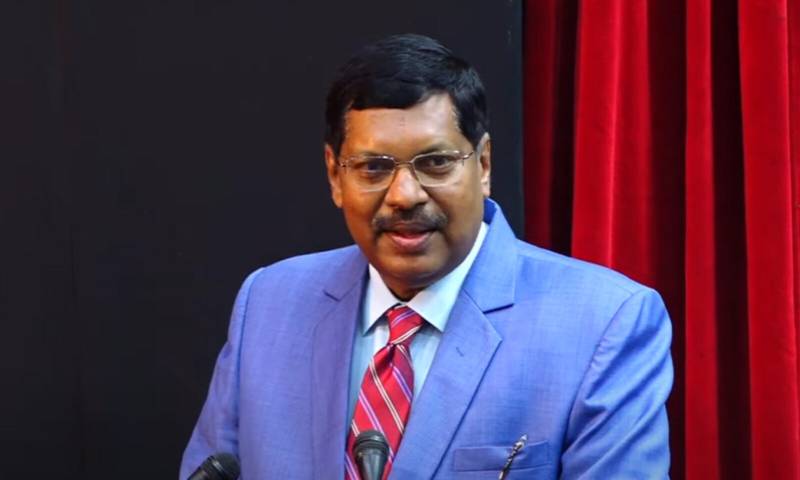
New Delhi: With just a month remaining before Chief Justice of India (CJI) D.Y. Chandrachud retires — correction, CJI B.R. Gavai — the Centre has initiated the formal process to name his successor. Sources confirmed on Thursday that the government has written to Chief Justice Gavai, who will demit office on November 23 upon turning 65, requesting him to recommend the next head of the judiciary.

As per the Memorandum of Procedure governing the appointment of judges to the higher judiciary, the senior-most judge of the Supreme Court, deemed fit for the role, is to be appointed as the Chief Justice of India. Following this convention, Justice Surya Kant, currently the senior-most judge of the Supreme Court, is expected to be recommended by CJI Gavai as his successor.

Born on February 10, 1962, in Hisar district of Haryana, Justice Surya Kant comes from a middle-class background. He graduated in law from Maharishi Dayanand University, Rohtak, in 1984, and went on to become the youngest Advocate General of Haryana in 2000 at the age of 38. He was appointed a judge of the Punjab and Haryana High Court in January 2004 and later served as Chief Justice of the Himachal Pradesh High Court from October 2018. His elevation to the Supreme Court came on May 24, 2019.
If appointed, Justice Surya Kant will take over as the 53rd Chief Justice of India on November 24, 2025, and will serve until February 9, 2027 — a tenure of nearly 15 months.
Traditionally, the outgoing Chief Justice recommends the senior-most judge as his successor — a convention breached only twice in Indian judicial history: first, when Justice A.N. Ray superseded three judges in 1973, and later in 1977, when Justice M.H. Beg was appointed over Justice H.R. Khanna.
Justice Surya Kant’s two-decade-long judicial career has been marked by several significant rulings on constitutional, civil, and social issues. He was part of the historic Bench that put the colonial-era sedition law on hold pending government review and delivered notable judgments on matters concerning Article 370, freedom of speech, electoral transparency, environmental protection, and gender equality.
Among his other key contributions, Justice Kant directed that one-third of seats in Bar associations, including the Supreme Court Bar Association, be reserved for women. He led the Bench that sought details of 65 lakh excluded voters in Bihar during a revision of electoral rolls and dealt with petitions related to farmers’ protests at the Shambhu border near Ambala.
He also served on the Bench that constituted a committee headed by former Supreme Court judge Justice Indu Malhotra to probe the 2022 security breach during Prime Minister Narendra Modi’s visit to Punjab. Justice Kant upheld the constitutionality of the One Rank, One Pension (OROP) scheme and was part of the Bench in the Pegasus spyware case, which asserted that the state cannot seek a “free pass under the guise of national security.”
Most recently, Justice Kant was a member of the seven-judge Bench that restored minority status to Aligarh Muslim University, overturning a 1967 verdict that had denied it.
Once confirmed, Justice Surya Kant’s appointment will continue the tradition of merit-based succession in the Supreme Court, bringing to the position a jurist known for his balanced approach and commitment to constitutional principles.
👉 Click here to read the latest Gujarat news on TheLiveAhmedabad.com