
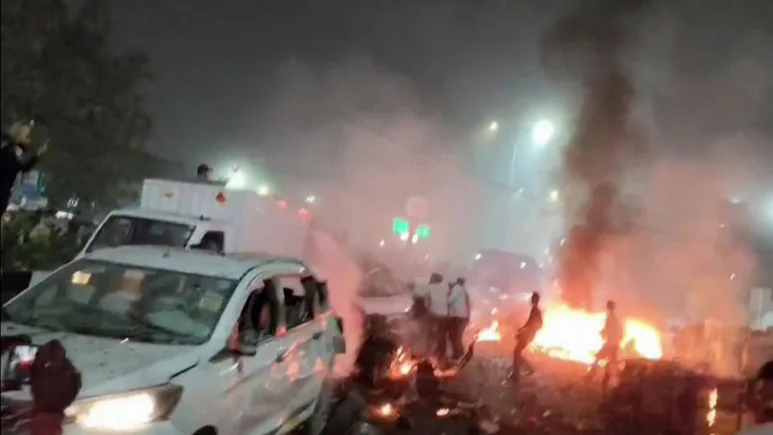
New Delhi: The investigation into the recent Delhi blast has taken a major turn, revealing that the explosion was triggered after members of a terror module panicked following the arrest of their associates and the exposure of the Faridabad-based terror network. According to security agencies, the group had been plotting large-scale attacks on several high-security locations in the national capital, including Sena Bhavan, the Air Force office, the BJP headquarters, and Parliament House Road, while Ayodhya’s Ram Temple and Kashi Vishwanath Temple were also on their radar.

So far, over 1,500 people have been detained across multiple states in connection with the probe. Investigators have identified the suicide bomber as Dr. Umar, who reportedly lacked sufficient materials to cause a high-intensity explosion, suggesting that the blast near Red Fort occurred accidentally. The suspects had allegedly stockpiled large quantities of ammonium nitrate over the past month.

During forensic and digital analysis, investigators recovered incriminating chats from Dr. Shaheen, one of the arrested suspects, in which she used code words — “Dawat” for a blast and “Biryani” for explosives. One of the messages read: “Dawat ke liye biryani taiyar hai” (The explosive is ready for the blast).
The National Investigation Agency (NIA) has now formed a special investigation team to lead the case, which has been linked to a Jaish-e-Mohammad (JeM) module recently unearthed by Indian agencies. Officials have confirmed that the Red Fort incident is connected to an FIR filed in Srinagar on October 19, 2025, after objectionable posters were discovered in Naugam, Jammu and Kashmir.
Between October 20 and 27, two suspects — Maulvi Irfan Ahmad Waghay from Shopian and Zamir Ahmad from Ganderbal — were arrested in connection with the case. On November 5, Dr. Adeel was detained from Saharanpur, Uttar Pradesh, while an AK-56 rifle and ammunition were recovered from Anantnag Hospital on November 7.
Further raids on November 8 at Al-Falah Medical College led to the seizure of additional weapons, pistols, and explosives. These developments resulted in the arrest of Dr. Muzammil, also associated with the Faridabad module. Subsequent operations uncovered a large cache of arms and bomb-making materials, further exposing the depth of the terror network.
The probe intensified with the arrest of Madarasi, a resident of Dhauj, Faridabad, on November 9, followed by a major recovery on November 10 — when agencies seized 2,563 kilograms of explosives from the house of Hafeez Mohammad Ishtiyaq, the Imam of Al-Falah Mosque in Mewat, along with 358 kilograms of detonators and timers.
In total, nearly 3,000 kilograms of explosive materials and bomb-making equipment have been recovered so far. Authorities believe the coordinated action of multiple agencies has prevented a series of devastating terror attacksplanned across Delhi and northern India.
The NIA’s ongoing investigation aims to trace the wider network, its foreign links, and possible sleeper cells that were aiding the module’s operations.
👉 Click here to read the latest Gujarat news on TheLiveAhmedabad.com