
In a major development, the Supreme Court on Thursday stayed the recently notified UGC Equity Regulations, describing them as “vague” and susceptible to misuse, while emphasising that the unity of India must be reflected across educational institutions.

The apex court was hearing petitions challenging the UGC’s new regulations, which have triggered widespread debate across the country. The petitions were filed by Mritunjay Tiwari, Advocate Vineet Jindal and Rahul Dewan, who contended that the regulations encourage discrimination against students from the general category.

Counsel appearing for the petitioners argued that any legal framework addressing caste-based discrimination must rest on intelligible differentia. Another counsel raised concerns about possible misuse in cases such as ragging, warning that students from the general category could face differential treatment based on identity. He further pointed out that the regulations focus exclusively on caste-related issues without adequately accounting for the broader realities of campus life.
‘Unity Of India Must Be Reflected’
The bench comprising Chief Justice of India Surya Kant and Justice Joymalya Bagchi observed that disparities exist even within reserved categories. “In most states now, even the legislature has realised that even in reserved committees, people have become haves and have nots,” CJI Kant remarked.
“After 75 years (of Independence), whatever we have gained towards a casteless society… are we going in a regressive direction?” he added.
Justice Bagchi noted that while Article 15(4) empowers states to enact special provisions for Scheduled Castes and Scheduled Tribes, any policy framework must avoid promoting social segregation within campuses. “The unity of India must be reflected in educational institutions. I hope we don’t go to segregated schools like US where blacks and whites went to different schools,” he said.
SC Calls UGC Rules ‘Vague’
CJI Kant observed that, prima facie, the language of the regulations appeared “vague” and required refinement to prevent potential exploitation. The bench also suggested that the Union government could consider constituting a committee of experts and scholars to examine the concerns raised.
The court ordered that the UGC Regulations, 2026, would remain in abeyance, while the 2012 anti-discrimination regulations would continue to operate. “The petitioners cannot be left remediless. We are not on general category complaints; the redressal system for the marginalised should remain in place,” CJI Kant said.
The Supreme Court issued a notice to the Centre and scheduled the next hearing for March 19. The bench said petitions filed by the mothers of Rohith Vemula and Payal Tadvi, along with issues raised in other connected matters, would be heard on that date.
What’s The Row?
The Centre recently notified the University Grants Commission’s Equality Promotion Regulations in Higher Educational Institutions, 2026, aimed at addressing caste-based discrimination and ensuring a safe, inclusive and dignified academic environment.
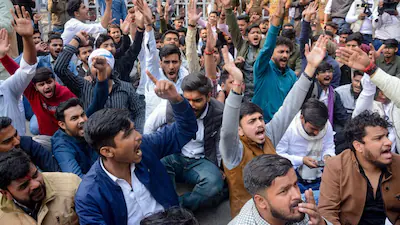
However, several upper-caste organisations have opposed the regulations, arguing that the provisions are open to misuse and could result in false complaints against students and faculty members. Yati Narasimhanand Giri, head of Dasna Peeth in Ghaziabad, has announced plans to launch a hunger strike at Jantar Mantar in Delhi in protest against the UGC rules.
👉 Click here to read the latest Gujarat news on TheLiveAhmedabad.com