
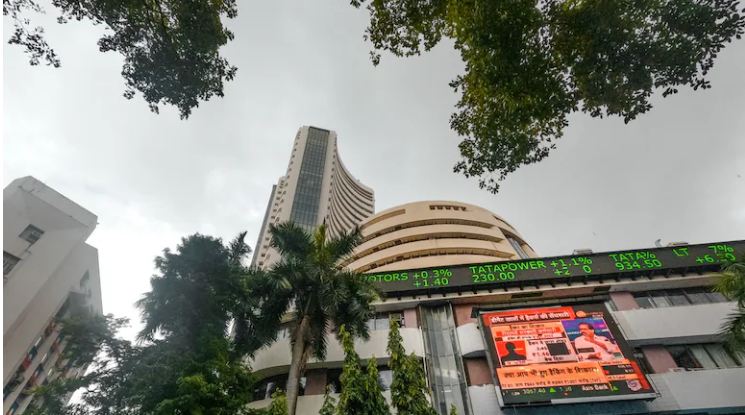
Indian equity markets plunged into turmoil on Monday as rising tensions between Iran, the US and Israel triggered a sweeping selloff on Dalal Street.

The 30-share Sensex tumbled as much as 2,743 points at the opening bell, hitting an intraday low of 78,543.73. The Nifty50 also slid sharply, falling 519 points to 24,659.25.

Although markets recovered some ground by mid-session, losses remained steep. The Sensex was down 1,087.65 points, or 1.34 per cent, at 80,199.54, while the Nifty slipped 323.60 points, or 1.29 per cent, to 24,855.05. The sharp gap-down erased nearly Rs 7.8 lakh crore in investor wealth, pulling the BSE’s total market capitalisation down to Rs 455.70 lakh crore from Rs 463.50 lakh crore in the previous session.
Heavyweight stocks bore the brunt of the decline. Larsen & Toubro, Reliance Industries, ICICI Bank, Mahindra & Mahindra, Bharti Airtel, HDFC Bank, Eternal and State Bank of India were among the key contributors to the fall in benchmark indices.
The selloff extended beyond large-caps. As many as 677 stocks on the BSE touched 52-week lows, including several BSE 500 companies such as AAVAS Financiers, Abbott India, Aditya Birla Lifestyle Brands, ACC, Afcons Infrastructure, Alkyl Amines Chemicals and Alok Industries. In contrast, only 48 stocks managed to hit fresh one-year highs.
Market breadth remained decisively negative. Of 3,765 actively traded stocks, 3,014 declined, 596 advanced and 155 remained unchanged. Foreign institutional investors led the selling, offloading equities worth Rs 7,536.36 crore in the previous session, while domestic institutional investors provided some support with net purchases of Rs 12,292.81 crore.
Global markets added to the pressure. South Korea’s Kospi fell 1 per cent, Hong Kong’s Hang Seng dropped 1.69 per cent, Japan’s Nikkei declined 1.53 per cent, while China’s Shanghai Composite was largely flat.
Where Should You Put Your Money?
Analysts at Emkay Global Financial Services believe the renewed Middle East tensions could push the Nifty towards the 24,500–25,000 range if the conflict continues beyond one to two weeks. India’s dependence on energy imports and relatively elevated valuations make it vulnerable to foreign outflows and currency volatility.
However, in their base-case scenario, Emkay expects the conflict to subside within a week, potentially leading to a swift market rebound — similar to past geopolitical shocks. They point out that while the Nifty fell nearly 3 per cent in the first week of Russia’s invasion of Ukraine in 2022 and remained subdued for about three months, it later posted three-month gains of 10.5 per cent after the October 2023 West Asia tensions and 2.2 per cent following the June 2025 Iran-linked escalation. Historically, Indian markets have absorbed such shocks faster than initially feared when disruptions are short-lived.
Sectors at Risk
If tensions escalate further, Emkay flags oil marketing companies, airlines and infrastructure firms with Middle East exposure as the most vulnerable. OMCs could face margin pressures, companies like L&T and KEC International may see execution risks, and IndiGo could encounter higher fuel costs and operational challenges. Capital goods, automobiles and consumer durables may also face downside risks if metal prices remain elevated.
Safer Bets in Volatile Times
On the defensive side, Emkay suggests upstream energy producers such as ONGC and Oil India, select metal companies like Hindalco, IT majors including Infosys and HCL Tech, pharmaceutical firms and reasonably valued private banks as relatively safer options. These sectors may benefit from higher commodity realisations, currency depreciation or resilient earnings profiles.
That said, risks remain. Potential windfall taxes, concerns around AI-led disruption in the IT sector, and any sharp spike in Brent crude prices towards $90–$100 per barrel could pose significant macroeconomic challenges for India.
For investors, the key lies in staying diversified, avoiding panic-driven decisions and focusing on fundamentally strong sectors that can withstand prolonged volatility.
👉 Click here to read the latest Gujarat news on TheLiveAhmedabad.com