
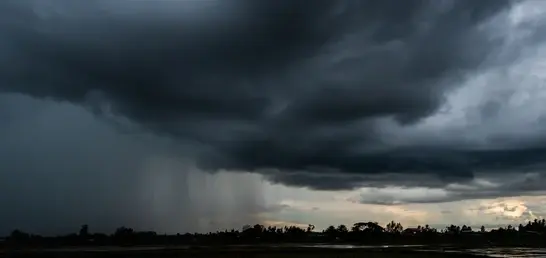
A massive weather system is rapidly developing over the Bay of Bengal, and meteorologists are warning that it could trigger severe rainfall, thunderstorms, lightning and damaging winds across several parts of eastern and northeastern India in the coming days.

Known as a Mesoscale Convective System (MCS), the gigantic cloud formation stretches nearly 3,000 kilometres — roughly the distance between Delhi and Chennai. Experts describe it as a giant “squall line” formed when hundreds of thunderclouds merge into one large weather system. Such systems develop when sea surface temperatures rise sharply and moisture-laden winds from the Arabian Sea interact with unstable atmospheric conditions over the Bay of Bengal.

Unlike ordinary thunderstorms, an MCS can unleash extremely heavy rain within a short span of time. Meteorologists say some regions could receive 200-300 mm rainfall overnight, while hilly areas may witness dangerous cloudbursts. The system is also capable of generating intense lightning activity, flash floods, destructive winds reaching up to 150 kmph, and widespread crop damage.
States including Odisha, West Bengal, Jharkhand, Bihar, Sikkim, Assam and Meghalaya are expected to face the highest impact. According to weather forecasts, coastal Odisha and Gangetic West Bengal remain under the highest alert due to the possibility of very heavy rainfall and severe thunderstorms between May 18 and May 21. Cities with poor drainage systems may witness severe waterlogging and disruption in transport services.
Experts say three major factors have intensified the threat this year — unusually warm waters in the Bay of Bengal, the active Madden-Julian Oscillation weather pattern, and the interaction between western disturbances and moisture-filled winds from the bay. Together, these conditions are creating an ideal environment for rapid storm intensification.
Authorities have advised people to remain indoors during lightning and thunderstorms, avoid waterlogged areas, and closely follow official advisories issued by the India Meteorological Department (IMD). Farmers have also been urged to take precautionary measures to protect standing crops before the severe weather system makes landfall.
👉 Click here to read the latest Gujarat news on TheLiveAhmedabad.com