
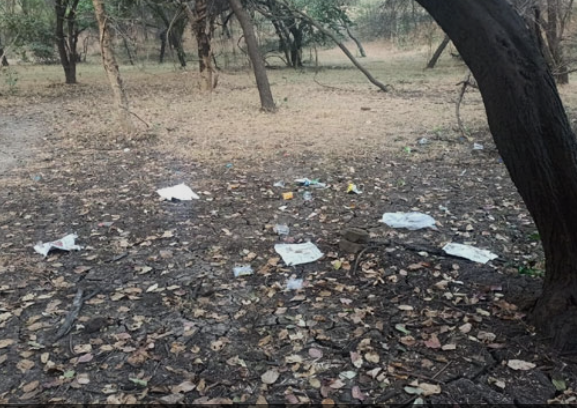
The trees in the Aamrai forest, situated in Sonegaon, near the Dr Babasaheb Ambedkar International Airport, have potentially seen 300 years’ worth of history. The several cuckoos, bulbuls, mynahs and peafowls greet people on their morning walks every day.

Known as one of Nagpur’s last surviving urban green lungs, this 300-year-old patch dates back to the Bhonsle era and features ancient mango trees, historic 16th-century wells, and temples. Imagine such a beautiful area which has given the residents shade and animals their homes, being cut down recklessly.
Nagpur, despite being known as the “Orange City” for our lush and green orange trees, is rapidly losing its green cover. Currently, Nagpur has 0.9 trees per person, and India has a mere 28. Stated in comparison to our biggest competitors, these numbers are frankly embarrassing. Canada has 94.4k trees per person, Russia leading second with 55.9k, the USA with 9.5k and China with 1.5k. Despite this, felling of 61-65 trees was ordered by the Nagpur Municipal Corporation (NMC) in the Aamrai region for a sewer pipeline project, spreading from Airports Authority of India land near Sahakar Nagar Ghat and Mulik Complex and another 138 trees for the London Street project. This particular region is historically and ecologically significant due to its presence since the Bhosale era and harbouring historic monuments such as wells and temples. It is home to several animal species and acts as a shelter for small urban wildlife. The trees marked for felling include: Babul, Ber, Hivar, Neem, Eucalyptus, Tamarind, Banyan, Jamun, Palash, Bel, and several others. Out of these, NMC has only marked three kinds as heritage trees, yet the remaining trees are potentially up to 93 years old. NMC also posted the notices on these trees before the objection and hearing period was completed.
The question arises: Should development come at the cost of dying greenery? According to people, development must co-exist with the environment. Sustainable development is extremely important for the future of our country. We have been learning about the effects of deforestation since the fifth grade. The CBSE curriculum has stressed the significance of conserving our environment, yet countless trees are still cut down in the name of urbanisation.
Several protests have been held since May 13 2026, thousands of people claim to have objected to the project, yet the pipelines are still ready to be placed. One such protest on the London Street on 24th May 2026 consisted of a human chain and a wide range of slogans such as “Gadkari kaka zhadanako kapa” and “Deva bhauzhadanakakhau”. People claim that since they voted the current administration in, the administration should, in turn, listen to what the people want.
A similar issue had arisen in 2021, where the NMC had planned on cutting 4930 trees in the Ajni area for the construction of the Inter Model Station (IMS). Back then, the Nagpur bench of the Bombay High Court issued a stay order for the 181 trees that were to be cut due to a PIL filed by a concerned citizen. However, 500 trees were unlawfully felled against the issued order.
The sentiment that then remains and influences the thoughts now. People claim that NMC doesn’t care about what they want; the notices are only being placed for the completion of formalities. NMC’s past failures regarding the Bhandewadi dump yard also seem to influence people’s opinions. Their previous disappointments increase the scepticism among the public. The unscientific dumping and mixing of waste that should’ve been segregated left people enraged. By January of 2026, NMC claimed that waste dumping would be 0%, yet only 44% of the city’s waste was processed.
Nagpur experiences a phenomenon that is known as the Heat Island Effect. What this means is that the city’s urban areas are warmer than the rural and remote ones. This occurs due to human modifications like concrete surfaces, reduced vegetation, high building density, and anthropogenic heat sources. On Tuesday, the 26th of May 2026, a city-wide heat alert was issued. If the trees are cut irresponsibly, the heat in Nagpur will increase to more than we can bear. Green cover loss directly correlates with higher temperatures, as mature trees provide shading and cooling that saplings cannot match. Losing the mature canopy will amplify the effect. Biodiversity loss, reduced cooling, and decline in the air quality are some of the many adverse effects of tree felling. Not to mention the historical and ecological significance. Environmentalists claim that losing this green cover that we proudly call “the green lungs of Nagpur” could be the start of irreversible environmental damage. When we cut trees, adjacent trees also get damaged and die later on without ever being counted, which results in more green loss.
Another question people ask is whether it is necessary to cut these trees for the pipeline. Nagpur has a major sewage crisis. Nagpur generates 520 million litres of sewage every day, while only 423 million litres are treated. However, no specific document by the NMC justifies why the route through Aamrai is the only feasible option or why other alternatives were refused. People claim that this appears to be a planning shortcut, and better options exist, such as rerouting, trenchless methods, and elevated or adjusted designs. Past NMC’s failures with replanting also add to the scepticism.
When trees are cut, a 1:5 method is used to replant them. However, there is no guarantee of monitoring the saplings or their survival with the heat wave in Nagpur. Environmental activists claim that NMC must redesign their projects in such a way that minimises environmental damage rather than routinely cutting trees.
Urbanisation and sustainability should always go hand in hand, or not much will be left for our future generations. We, the youth, refuse to inherit a concrete jungle. The importance of trees isn’t unknown to the public. The irresponsible cutting of trees needs to stop. People are not against development; people are against development that comes at the cost of our greenery and historical heritage. It’s 2026, and we have many better alternatives. Sustainable development is the future, and it’s high time we do better.

Author: Narayani Avantika Ramesh Lekurwale
👉 Click here to read the latest Gujarat news on TheLiveAhmedabad.com