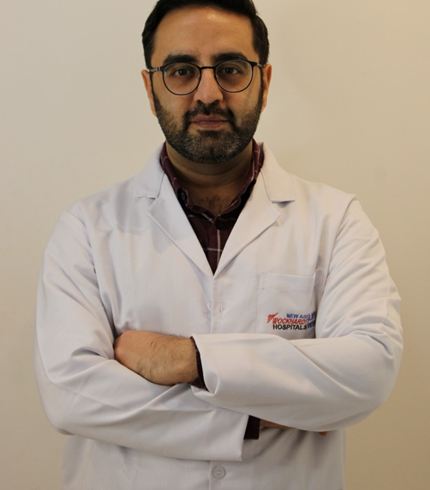
A conversation with Dr. Kartik Multani, Consultant Brain and Spine Surgeon, Wockhardt Hospitals, Nagpur

When lives are paused inside the operating theatre, every movement matters. For Dr. Kartik Multani, one of Central India’s leading neurosurgeons and a brain tumor specialist, surgery isn’t just about precision — it’s about preserving who a person is. From treating aggressive neurological disease to guiding patients through recovery, his approach blends high science with deep empathy.

When asked what it feels like to step into the operating theatre, Dr. Kartik Multani pauses for a moment before replying:
“It’s not just a room. There’s a sacredness in the OT,” he says. “To me, it’s my sanctum sanctorum. It’s where science meets soul. The silence isn’t empty — it’s filled with focus, intention, and care.”
A recipient of the President’s Gold Medal. Dr. Multani’s career spans leading institutions like, JIPMER (Puducherry), and Tata Memorial Centre (Mumbai), where he completed a dedicated fellowship in Neuro-Oncology.
Despite these credentials, he speaks more about responsibility than achievement.
“Operating on the brain is not simply a technical exercise. You’re working at the intersection of identity, memory, and movement. A fraction of a millimeter can change someone’s life.”
High-Grade Tumors: The Fight for Function and Life
Few diagnoses carry the gravity of a high-grade glioma — an aggressive brain tumor that often arises near eloquent areas responsible for speech, movement, or cognition. For Dr. Multani, these cases are a test of both courage and control.
Q: Many patients with high-grade brain tumors fear surgery. What do you tell them?
“Fear is natural — both for the patient and the family. These tumors are aggressive, and the stakes are high. But what gives me confidence is how far we’ve come with technology — from awake craniotomy to connectomic-guided resections, and intraoperative neuromonitoring. Operating on such tumors is not just about removing disease — it’s about preserving identity. You’re working millimeters away from someone’s ability to walk, speak, or recognize their loved ones.
I always say: We don’t chase tumors recklessly; we chase them safely.”
Q: Can you share a case that reflects this philosophy?
We operated on an 18-year-old girl who had nearly lost hope after being told that her tumor was inoperable due to its proximity to motor pathways.
“She had a right-sided high-grade glioma abutting motor fibres (the fibres which control movement of face, arm & legs). With detailed fiber tracking in MRI and intraoperative neuromonitoring, we planned a surgical path that allowed safe access while preserving function. We performed a craniotomy guided by these advanced techniques, leaving behind only a thin sliver of tumor tightly adherent to motor tracts.”
Following surgery, she underwent appropriate chemo-radiotherapy. Today, three years later, she is in her second year of engineering in Computer Sciences, fully independent, with no neurological deficits.
“That is the kind of outcome that stays with you,” he says quietly. “It reaffirms why we chase that last millimetre — safely, precisely, and purposefully.”
Q: What do you mean by “the last safe millimetre”?
In brain tumor surgery, Dr. Multani emphasizes that every millimetre matters — not just in terms of what is removed, but in what is preserved.
“High-grade brain tumour demand maximal resection, but not at the cost of who the patient is. Our goal is maximal safe resection — guided by IONM, fluorescein imaging, and functional mapping. Precision isn’t about being aggressive. It’s about being meticulous.”
He believes that the greatest triumphs in neurosurgery often lie in what doesn’t happen.
“Sometimes success isn’t visible on a scan — it’s in the fact that a patient didn’t lose speech, didn’t become hemiplegic, didn’t need help to eat or walk. Those are the silent victories.”
Q: Do you believe emotions have a place in such a technical field?
Dr. Multani rejects the stereotype that surgeons must detach emotionally to do their job.
“There’s an assumption that we become immune to emotion. But that’s far from the truth. The emotions aren’t loud — but they’re steady. There’s pressure, there’s trust, and there’s a quiet resolve. What we do affects families, futures — it’s impossible not to feel that.”
Q: What challenges do patients face after surgery — particularly those with high-grade brain tumours?
He adds that post-operative care often brings its own challenges.
“Recovery isn’t just physical. Many patients with high-grade tumors deal with fatigue, fear, or cognitive shifts. I make it a point to guide them beyond the surgery — with honesty, empathy, and support. The goal isn’t just to extend life — it’s to protect quality of life.”
Q: You speak of the Operating Theatre with reverence. What makes it so special to you?
He says. “It may look like a room full of equipment, but for those of us inside, it’s where lives are paused and restarted. It’s where science, responsibility, and intention converge.”
He credits his team — anesthetists, scrub nurses, technicians — for creating a rhythm where words become minimal and trust takes over.
“Nothing in neurosurgery is done alone. The operating theatre is like a symphony stage — every instrument, every hand, moves in harmony, where surgical precision performs the silent art of healing. That rhythm — the unspoken flow between team members — only comes with mutual trust and respect.”
Even the most technical actions, he notes, carry layers of care.
“How we position a patient, how we handle tissue, how gently we close a wound — all of it is care, even if unspoken.”
Q: What does success look like in neurosurgery to you?
Dr. Multani defines success not just by tumor removal or survival metrics, but by something deeper.
“Sometimes, success means making the right call when the path isn’t easy. Sometimes it’s helping a young student return to college. Sometimes it’s ensuring a parent can still hold their child’s hand. Neurosurgery may be complex — but its purpose is profoundly human.”
When asked what keeps him going in such a demanding field, he smiles softly:
“The OT is where I feel most aligned with my purpose. Every patient reminds me that this work carries meaning. Behind every scan is a person, a family, and a future worth protecting.”
👉 Click here to read the latest Gujarat news on TheLiveAhmedabad.com