
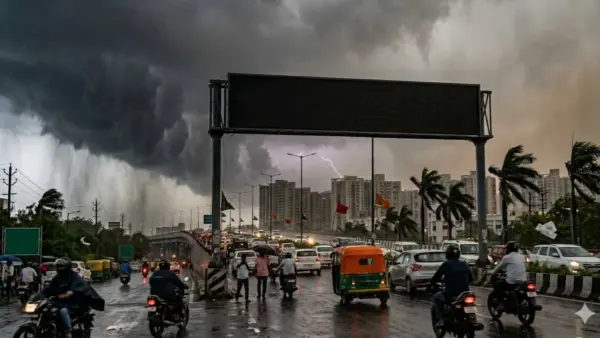
The sluggish progress of the Southwest Monsoon has emerged as a major concern across the country, with India recording a significant rainfall deficit during the crucial early phase of the rainy season.

According to data from the India Meteorological Department (IMD), the country received 42.1 mm of rainfall between June 4 and June 18 against the normal average of 72.2 mm, resulting in a rainfall deficit of nearly 42 per cent. The shortfall has raised concerns among farmers, water resource managers and policymakers, particularly as the kharif sowing season gathers pace.

Rainfall deficit widens across regions
The impact of the weak monsoon has been most visible across Central, Eastern and Peninsular India, where several districts have recorded rainfall deficits ranging from 20 to 90 per cent. In contrast, parts of Northwest India and the Western Himalayan region have received above-normal rainfall.
The uneven distribution of rainfall has delayed agricultural activities in many areas, with farmers in several states postponing sowing operations due to inadequate soil moisture.
Weak monsoon circulation blamed
Meteorologists attribute the delayed monsoon activity to weak atmospheric circulation over the Indian subcontinent. Satellite observations indicate that rain-bearing cloud systems have remained concentrated over northern parts of the country and the Western Himalayan region, aided by active western disturbances.
At the same time, large parts of Central India, including Maharashtra, Gujarat and Madhya Pradesh, have witnessed limited cloud formation and weak rainfall activity.
Weather experts noted that the Arabian Sea branch of the monsoon has progressed slowly, while the Bay of Bengal branch has largely produced isolated thunderstorms over eastern and northeastern regions, insufficient to offset the overall rainfall deficit.
Maharashtra among worst affected
Maharashtra is among the states facing the sharpest impact of the delayed monsoon and is heading towards one of its driest Junes in recent years. Water conservation measures have already been initiated in some regions, while farmers in Vidarbha and adjoining parts of Madhya Pradesh continue to await substantial rainfall before beginning large-scale sowing operations.
Forecasters believe a meaningful revival of the monsoon will require simultaneous strengthening of both the Arabian Sea and Bay of Bengal systems. A strong low-pressure area could help draw moisture inland and accelerate rainfall activity, but meteorologists say there are currently no immediate signs of such a development.
Crucial weeks ahead
Weather experts are closely monitoring atmospheric conditions during the second half of June. If moisture inflow fails to strengthen and no major weather systems develop, the rainfall deficit could persist deeper into the month, potentially affecting agricultural productivity, reservoir storage and drinking water availability.
Monsoon’s 13-million-year history offers perspective
Despite the immediate concerns, climate scientists point out that the Indian monsoon is a remarkably resilient system that has endured for millions of years.
Professor Anil K. Gupta, paleoclimatologist, faculty member at IIT Kharagpur and former Director of the Wadia Institute of Himalayan Geology, said geological evidence suggests the monsoon has existed over the Indian subcontinent for nearly 13 million years.
“The monsoon has been in this landmass for the last 13 million years. As long as we have the present-day landmass configuration, the monsoon will remain,” Prof Gupta said.
According to him, the unique geographical configuration of the Indian peninsula and the Himalayan mountain range creates the pressure differences necessary for seasonal wind reversals and monsoon rainfall.
“As long as the Indian landmass remains similar, with the peninsula in the south and the Himalayas in the north, the monsoon system will continue to exist,” he explained.
Lessons from ancient droughts
While the monsoon system itself remains stable over geological timescales, its intensity and distribution have fluctuated significantly in the past.
Climate records indicate that Asia experienced a major drought event around 4,200 years ago, leading to widespread environmental stress and population movements.
“We see evidence of a major drought around 4,200 years ago, when large parts of the Asian landmass suffered severe aridity and population migration was widespread. Such extreme events have occurred in the monsoon system before,” Prof Gupta noted.
Scientists caution that although such fluctuations have historically occurred naturally, modern climate change and global warming are introducing additional pressures that could influence rainfall patterns and increase the frequency of extreme weather events.
For now, however, experts stress that while this year’s delayed monsoon remains a matter of concern, fears of a complete collapse of India’s monsoon system are not supported by geological and climatic evidence.
👉 Click here to read the latest Gujarat news on TheLiveAhmedabad.com