
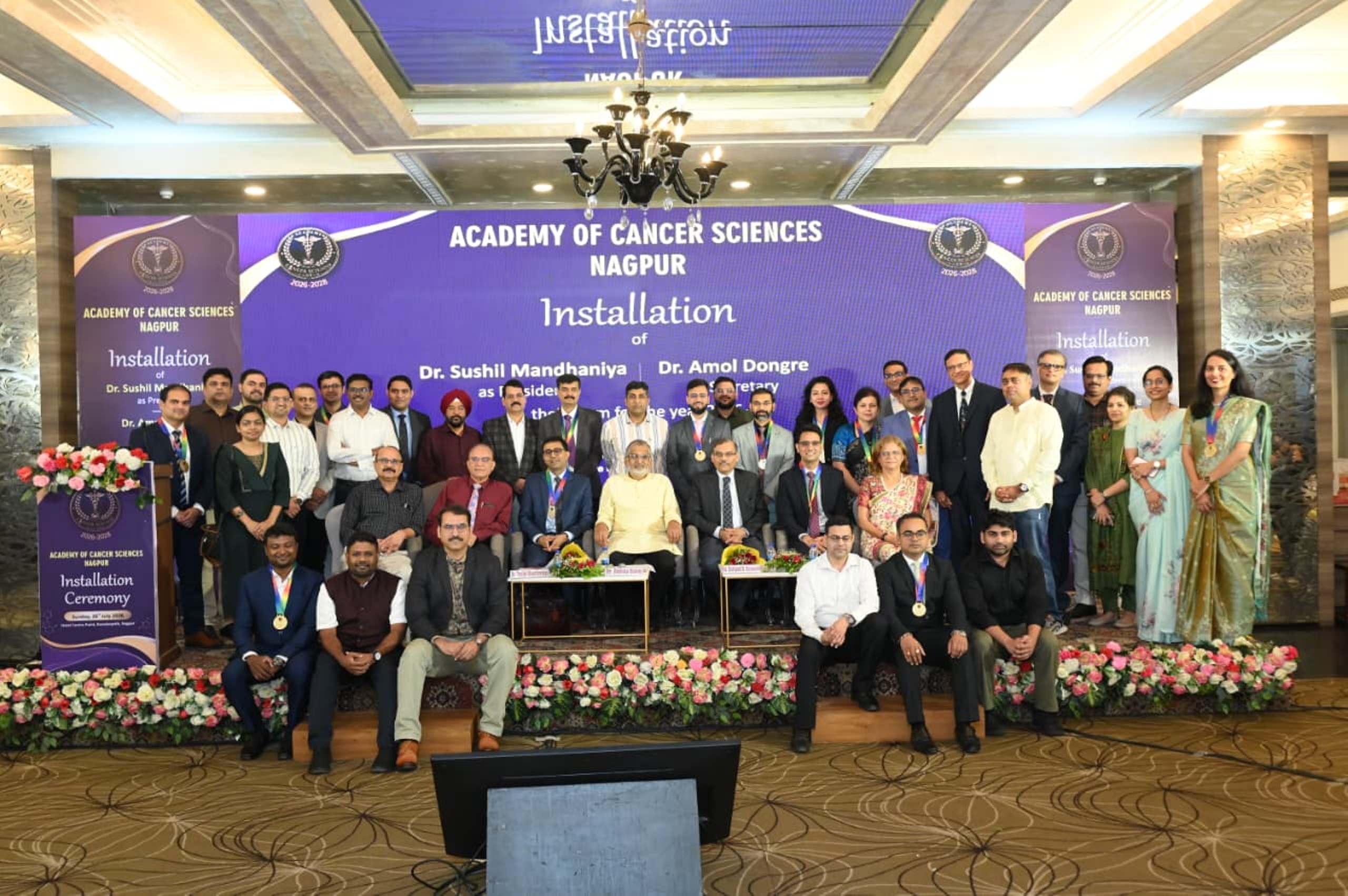
A historic milestone in the field of oncology was achieved today with the successful maiden installation ceremony of the Academy of Cancer Sciences (ACS) at Hotel Centre Point, Nagpur. The newly formed multidisciplinary academic society is dedicated to improving cancer care through collaboration, education, research, and community outreach.

On this occasion, Dr. Sushil Mandhania was formally installed as the Founding President, while Dr. Amol Dongre assumed office as the Honorary Secretary of the Academy.

The ceremony was graced by two distinguished stalwarts in Indian healthcare as Chief Guests—Padma Shri Dr. Abhay Bang, renowned public health expert and founder of SEARCH, Gadchiroli, and Dr. Shripad Banavali (formerly Dean, Tata Memorial Hospital, Mumbai), one of India’s most respected medical oncologists. Their presence and guidance added immense value to the inaugural event.
More than 300 doctors representing medical oncology, surgical oncology, radiation oncology, pathology, radiology, nuclear medicine, palliative care, and allied specialties from across the region participated in the event, reflecting the strong commitment of the oncology fraternity towards collaborative cancer care.
Bridging the Gap Between Rural and Urban Cancer Care
The central theme of the inaugural conference was “Bridging the Gap Between Urban and Rural Cancer Care.” The discussions highlighted the urgent need to ensure that high-quality, evidence-based cancer treatment reaches every patient irrespective of geography, financial status, or socioeconomic background.
From AIIMS to Nagpur: Beyond Academia
In his presidential address titled “My Journey from AIIMS to Nagpur: Beyond Academia,” Dr. Sushil Mandhania shared his two-decade journey of practicing oncology in Central India and the invaluable lessons learnt while treating patients from rural and underserved communities.
He emphasized that the best oncology is not necessarily the most expensive oncology, but oncology that is evidence-based, patient-centric, affordable, and adapted to local realities. He highlighted that treatment decisions should always take into account the patient’s financial capacity, social support, accessibility to treatment facilities, nutritional status, and family circumstances.
Dr. Mandhania stressed the philosophy of “Local Problems, Local Solutions,” advocating that healthcare models should be designed according to the needs of the local population rather than simply replicating practices from metropolitan centres.
He also emphasized the importance of empathy in clinical practice, stating that oncologists should treat the patient, not merely the reports. He reminded the audience that while medical literature provides the foundation of knowledge, real-life patients remain the greatest teachers of medicine, guiding clinicians to deliver compassionate, individualized, and meaningful care.
Dr. Abhay Bang Highlights the Need for Prevention
Delivering an inspiring keynote address, Padma Shri Dr. Abhay Bang presented valuable epidemiological data from rural Gadchiroli, highlighting the growing burden of cancer in rural India.
He identified tobacco and alcohol consumption as the leading preventable causes of cancer in the region and strongly advocated shifting the national focus from treatment alone to prevention and early detection.
Dr. Bang called for a coordinated effort involving healthcare professionals, social organizations, educational institutions, community leaders, and government administration to reduce tobacco and alcohol use. He emphasized that effective public health policies, strict enforcement against tobacco and alcohol sales, widespread awareness campaigns, and community participation are essential to significantly reduce the burden of cancer in India.
Affordable Oncology: Experience from Tata Memorial Hospital
In his thought-provoking address, Dr. Banavali shared his vast experience in developing low-cost, evidence-based treatment protocols during his tenure at Tata Memorial Hospital, Mumbai.
He highlighted how several innovative and economical treatment strategies are now being successfully implemented at Shri Valawalkar Hospital, Dervan, achieving excellent outcomes in terms of disease control, survival, cure rates, and affordability. His presentation reinforced the message that quality cancer care can be delivered effectively even with limited resources, provided scientific evidence and innovation are combined with compassion.
A Vision for the Future
The Academy of Cancer Sciences aims to serve as a common academic platform for oncologists and allied specialists to promote continuous medical education, collaborative research, multidisciplinary patient care, mentorship of young oncologists, and public awareness initiatives.
The newly established Academy envisions creating stronger partnerships between academic institutions, government healthcare systems, private hospitals, and community organizations to ensure that every cancer patient receives timely, affordable, and evidence-based treatment.
The inaugural function received an overwhelming response from the medical fraternity and was widely appreciated for its scientific content, visionary leadership, and socially relevant theme. The event concluded with a collective commitment to work towards reducing disparities in cancer care and making quality oncology accessible to every patient across urban and rural India.
👉 Click here to read the latest Gujarat news on TheLiveAhmedabad.com