
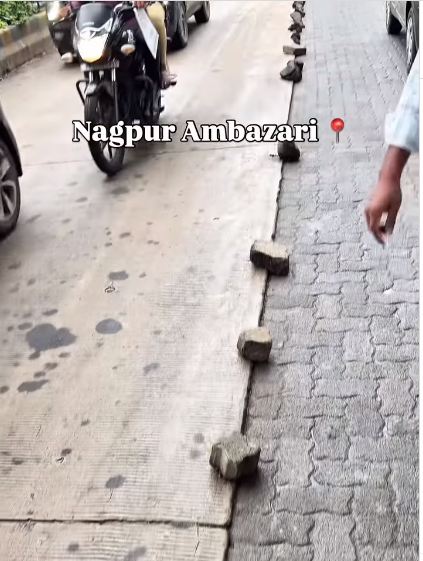
Multiple accidents on Ambazari Road Wednesday morning brought renewed attention to a persistent road design flaw in Nagpur, the mismatch in levels between the main concrete stretch and the adjoining interlocking block patches. This uneven surface has become a common and dangerous issue across the city.
In a viral video, residents are seen pointing out a deep gap and risky surface-level difference that caused five people — including an elderly couple — to fall on Ambazari Road. Locals later placed stones at the spot in a desperate attempt to prevent more accidents.

“This road is a trap. We’ve had enough,” said a bystander as people gathered at the spot. Following the viral video, the state Public Works Department (PWD) rushed to begin repairs on Thursday afternoon. Workers started removing the interlocking blocks along the flawed patch and adjusted them to align with the main road level.
This faulty stretch was built by the Public Works Department (PWD), but the issue isn’t confined to just one agency. Shockingly, similar uneven road designs can be found across several key routes in Nagpur — including Pratap Nagar, East High Court Road, Khamla, the Inner Ring Road, and Residency Road. These roads, maintained by various agencies such as the Nagpur Improvement Trust (NIT), Nagpur Municipal Corporation (NMC), and the National Highway Authority of India (NHAI), continue to endanger thousands of commuters every day.
Two-wheeler riders bear the brunt of these flawed roads, often falling victim to tyre-trapping gaps that become invisible during rains. Sadly, this isn’t a case of ignorance — it’s a tragedy born out of sheer negligence. Despite over ₹2,000 crore being spent by the NMC and other agencies to replace tar roads with supposedly long-lasting cement concrete ones, safety remains a major concern. The real issue lies with the interlocking block (I-block) stretches laid next to concrete roads for future utility work. Poor upkeep has caused many of these patches to sink or crack open, turning them into a continuous hazard zone for commuters.
To avoid the jarring ride over sunken I-block stretches, most two-wheeler riders prefer staying on the smoother cement road. But when a heavy vehicle approaches from behind or in the opposite lane, they are often forced to swerve left—only to lose balance while transitioning onto the uneven, lowered I-blocks. This sudden shift frequently results in accidents and injuries. Back in July 2024, the Nagpur bench of the Bombay High Court, comprising Justices Nitin Sambre and Abhay Mantri, had pulled up authorities for the substandard quality and misalignment of roads. The judges noted that even newly constructed cement roads suffered from poor design, drainage failures, and frequent waterlogging.
The judges had directed the formation of an expert committee to tackle the issue, but little has changed on the ground. After the court’s scathing remarks, NMC chief engineer Leena Upadhey had assured action. “We are identifying accident-prone areas caused by uneven I-blocks,” she said, adding that surveys would be carried out before initiating repairs. However, even a year later, those assurances remain largely on paper. A senior traffic police official also acknowledged that the abrupt level difference between cement concrete roads and adjoining interlocking (I) blocks is leading to accidents. He stated that they plan to take up the matter with the NMC’s traffic department and other concerned road authorities to seek necessary corrections.
Experts from VNIT have urged the NMC to implement a Pavement Management System, a scientific approach to ensure surface level uniformity.
According to a media report, Prof Vishrut Landge of VNIT’s Civil Engineering Department said, “It’s not just poor planning — it’s administrative apathy. These roads are not fit for public use.” He added that uneven surface levels are causing the accidents. “This can be repaired. The engineers have to pay attention while executing the work. More than 15mm of level difference causes such accidents if the vehicle speed is more than 25kmph. There must be a road safety audit of all roads to identify such faults.”
👉 Click here to read the latest Gujarat news on TheLiveAhmedabad.com