
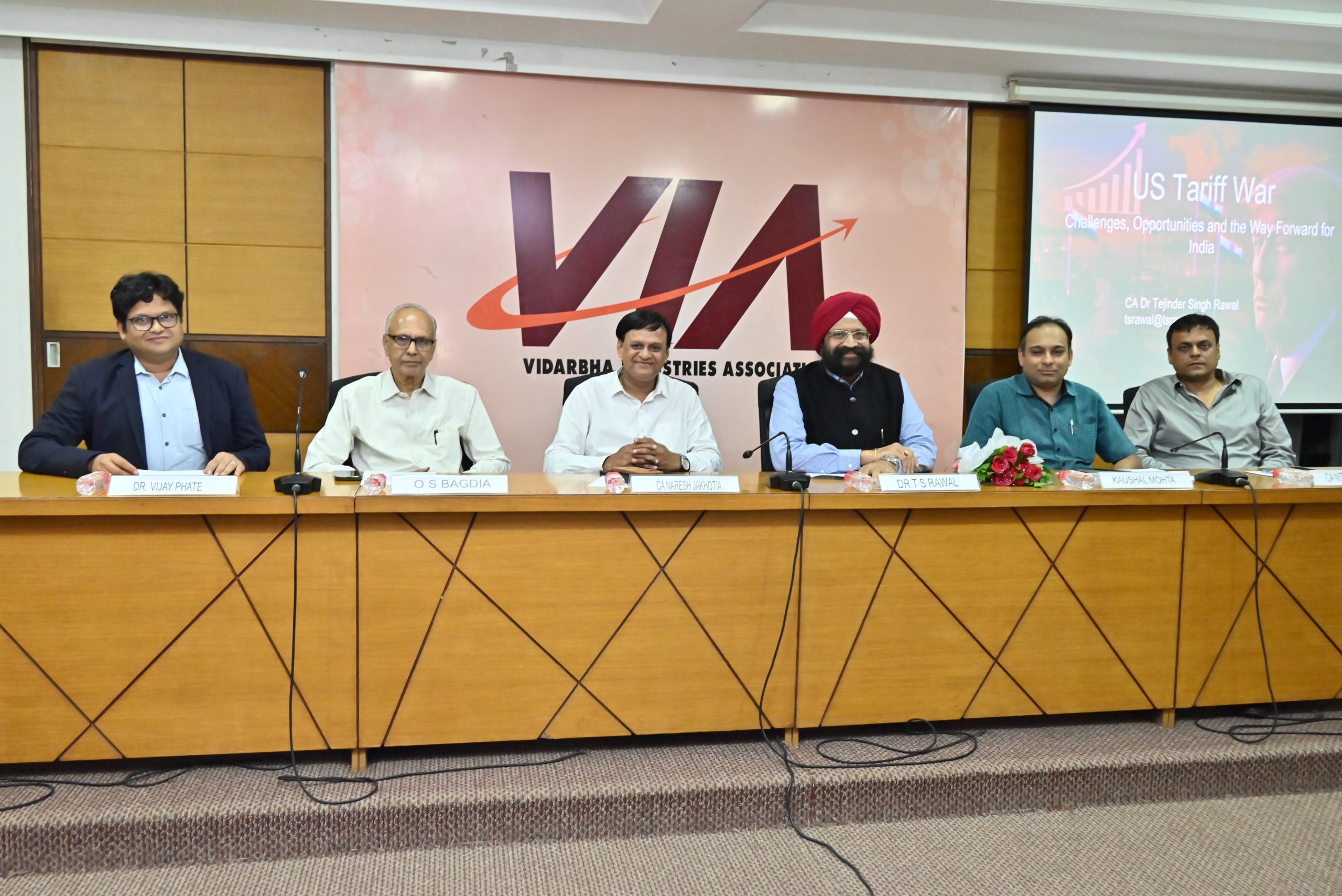
Vidarbha Industries Association (VIA) Finance & Economy Forum organised a thought-provoking session on “USA Tariff War – Challenges, Opportunities & Way Forward for India” at VIA Auditorium. The session was conducted by eminent economist CA Dr Tejinder Singh Rawal, who shared an in-depth analysis of the ongoing US tariff measures, their global trade implications, the challenges for Indian exporters, and strategies for navigating the crisis.

Dr Rawal explained that “modern wars are fought with taxes, not tanks”, noting that tariff conflicts can quietly but severely damage economies through order cancellations and job losses. He outlined the backdrop, over the past two years, the United States has intensified trade protectionism, imposing 50% tariffs on most Indian goods in August 2025 as retaliation for India’s continued import of Russian oil. This move, India asserts, is “unfair and unjustified”, particularly as several other countries engage in similar trade without equivalent penalties.

He highlighted the magnitude of the crisis, over half of India’s exports to the US now face prohibitive duties, putting Indian products at a 30–35% cost disadvantage against competitors like Bangladesh and Vietnam, who enjoy much lower tariffs. Labour-intensive sectors such as textiles, apparel, leather, carpets, handicrafts, and gems & jewellery — largely MSME-driven — are among the hardest hit, with fears of large-scale job losses.
Dr Rawal also touched upon the impact on Vidarbha, which exported over ₹3,000 crore worth of goods to the US in FY2025. While pharmaceuticals, the region’s largest export category, remain unaffected, products such as textiles, cotton yarn, transmission towers, tractors, and handcrafted jewellery have already seen order cancellations.
He also addressed the geopolitical and structural challenges compounding the crisis — from the paralysis of the WTO’s dispute resolution system and rising non-tariff barriers, to India’s over-reliance on a few markets and products. The US has also been pushing for wider access to India’s agriculture and dairy sectors, a politically sensitive area given the livelihood dependence of millions of small farmers.
Despite the severe short-term impact, Dr Rawal identified emerging opportunities. He emphasised the need for India to diversify export markets beyond the US, Boost manufacturing competitiveness and value-added exports, Invest aggressively in high-technology self-reliance, Leverage the “China+1” supply chain diversification trend, Rationalise non-tariff barriers while maintaining quality and safety, Upgrade logistics and infrastructure under flagship projects like Sagarmala and Bharatmala
Dr Rawal argued that this moment could serve as India’s “real 1991 moment” — a chance to implement bold reforms, encourage private sector risk-taking, and transform the economy towards self-reliance and global competitiveness. The Government’s ₹20,000 crore “Brand India” initiative, export promotion measures, FTAs with key partners, and focus on technology-driven manufacturing are already steps in that direction.
Earlier, CA O S Bagdia, Chairman of VIA Finance & Economy Forum, set the context, highlighting the unprecedented scale of tariff escalation in recent years. CA Vikas Gupta, Convener – VIA Finance & Economy Forum, conducted the proceedings, while Kaushal Mohta, Hon. Secretary – VIA, welcomed Dr Rawal with a floral bouquet. CA Naresh Jakhotia, Vice President – VIA, summed up the session and proposed the formal vote of thanks. The event drew active participation from exporters, importers, industrialists, and professionals.
👉 Click here to read the latest Gujarat news on TheLiveAhmedabad.com