
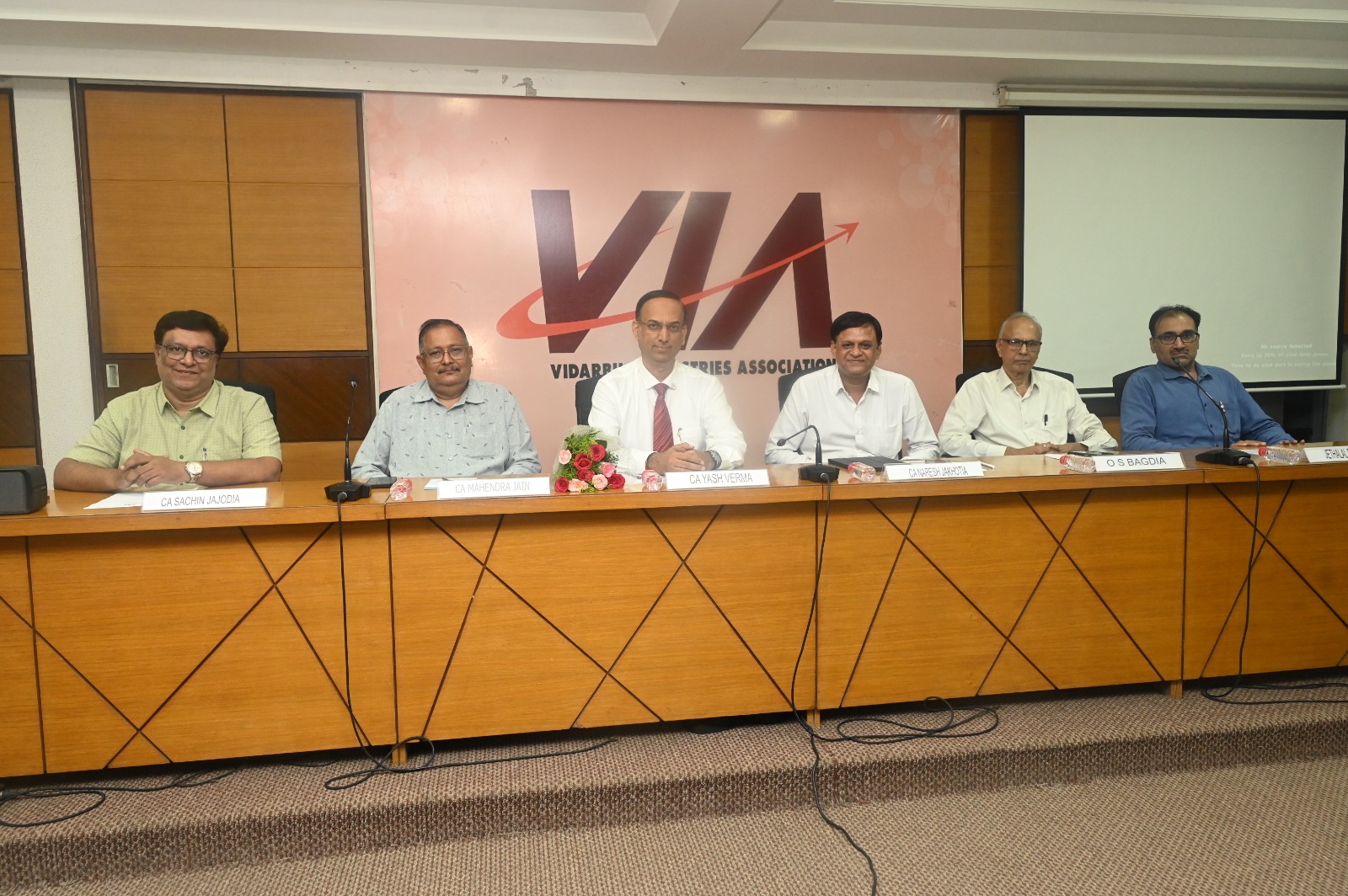
VIA Taxation & Corporate Law Forum organised an insightful session on “Understanding the New Format of Financial Statements for Non-Corporate Entities (NCEs)” at VIA Auditorium, Nagpur. The session was conducted by CA Yash Verma, explained in detail the revised ICAI format, its applicability from FY 2024–25, and its far-reaching implications for trade, industry, professionals, and other stakeholders.

The Institute of Chartered Accountants of India (ICAI), through its Accounting Standards Board (ASB), has issued a Guidance Note on Financial Statements of Non-Corporate Entities (2022), upgrading its earlier technical guide. This aims to standardise reporting for partnership firms, sole proprietorships, HUFs, trusts, societies, and other NCEs (excluding LLPs), ensuring uniformity, comparability, and greater transparency in financial reporting.

CA Verma explained that a complete set of financial statements under the new guidance includes a balance sheet, statement of profit & loss, cash flow statement (where applicable), and notes to accounts with significant accounting policies and supplementary disclosures.
The new formats bring better structure, classification into ‘Equity & Liabilities’ and ‘Assets’, segregation of current and non-current items, detailed disclosure requirements, and international alignment with IFRS.
A major change is the categorisation of NCEs into Levels I–IV based on turnover and borrowings, with varying compliance requirements. Level I entities must meet all disclosure norms, while MSMEs (Levels II–IV) enjoy certain exemptions but must still follow the prescribed format. Comparative figures for the previous year are mandatory.
The session compared the old and new formats of the balance sheet and profit & loss account, highlighting additions such as detailed partner capital account movements, granular asset classification, MSME dues disclosure, contingent liabilities, and improved notes on related party transactions, segment reporting, and events after the reporting period. The new cash flow statement format was also discussed.
CA Verma emphasised that non-compliance could have serious consequences, rejection of financial statements by tax authorities, banks, and regulatory bodies, affecting loan sanctions, tender eligibility, and contract awards; Increased scrutiny during tax assessments; reputational damage, loss of stakeholder trust, and difficulty in attracting investment or business partnerships, Potential regulatory penalties, legal disputes, and operational disruptions.
From an auditor’s perspective, failure to follow the format can result in modified opinions (qualified, adverse, or disclaimer), ICAI disciplinary action, legal consequences, and loss of professional credibility. To ensure smooth implementation, CA Verma advised NCEs to take proactive measures: Engage qualified professionals early. Conduct a compliance gap analysis. Upgrade accounting systems/software (such as the Tally Prime Excel-based XML add-on for automatic mapping to ICAI classifications). Strengthen internal controls. Organise training for finance and management teams. Maintain transparent communication with stakeholders.
The session was interactive, with participants from the industrial, business, and professional community gaining practical clarity on the new requirements. The guidance is expected to improve comparability, facilitate better decision-making, and enhance the credibility of NCEs in the eyes of regulators, lenders, and investors.
Earlier, CA O S Bagdia, Chairman – VIA Taxation & Corporate Law Forum, welcomed the guest speaker with a floral bouquet. CA Naresh Jakhotia, Vice President – VIA, delivered the opening remarks, stressing the importance of aligning with evolving statutory norms. CA Sachin Jajodia, Convener of the Forum, summed up the session and proposed a formal vote of thanks.
The programme was well attended by industrialists, accountants, and business leaders. Participants appreciated the practical insights and detailed comparisons provided, making the session highly beneficial for those involved in preparing or analysing financial statements of NCEs.
👉 Click here to read the latest Gujarat news on TheLiveAhmedabad.com