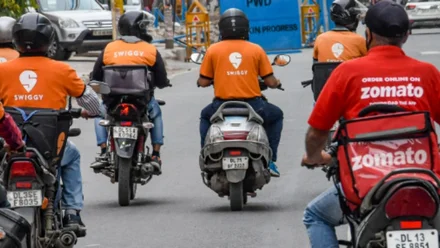
In a major policy shift aimed at strengthening the safety net for India’s growing gig workforce, the government has mandated that online aggregators — including platforms such as Zomato, Swiggy and Zepto — will now contribute up to 2% of their annual turnover towards welfare measures for gig and platform workers. This contribution will be capped at 5% of the total payments made by the platforms.

The announcement came alongside the rollout of four Labour Codes on Friday, including the landmark Code on Social Security (2020), which for the first time formally defines key terms such as aggregator, gig worker, and platform worker.

According to the Ministry of Labour and Employment, the new code aims to extend comprehensive social security coverage to all categories of workers by offering benefits such as provident fund, Employees’ State Insurance Corporation (ESIC) coverage, insurance, and other safety provisions.
A key feature of the reform is the introduction of an Aadhaar-linked Universal Account Number (UAN) for gig and platform workers. The ministry said this will ensure portability of benefits across states and make welfare schemes more accessible regardless of worker migration.
The code also broadens social security access to unorganised-sector workers while integrating digital compliance systems and facilitator-based mechanisms to streamline implementation. In addition, a dedicated Social Security Fund will be created to finance welfare schemes, with revenues from the compounding of offences also being channelled into this fund.
Reacting to the announcement, an Uber spokesperson said, “Uber welcomes the government’s move to implement the new labour codes, including the Code on Social Security. Uber looks forward to working closely with the government to ensure the speedy and effective implementation of these reforms.”
Commenting on the broader need for such measures, Minu Dwivedi, partner at JSA Advocates & Solicitors, noted that evolving work models had made updated frameworks essential. “There was an emerging need to address issues related to professional/freelance (gig) services, technology enablement, and new ways of working, which necessitated contemporary work arrangements to meet the current needs of corporates, public sector employers, individual workforce, consultants, and freelance/gig workers,” she said.
👉 Click here to read the latest Gujarat news on TheLiveAhmedabad.com