
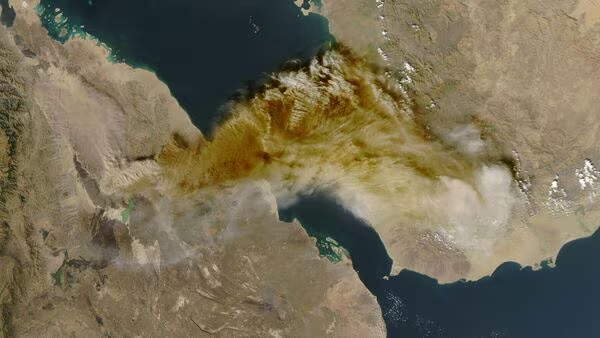
A massive windborne cloud of volcanic ash from Ethiopia drifted across several regions of Northwest India on Monday night, affecting visibility and disrupting flight operations as it travelled eastward across the subcontinent. The ash originated from the Hayli Gubbi volcano, which erupted on Sunday for the first time in nearly 12,000 years.

According to the India Meteorological Department (IMD), the ash plume was circulating at an altitude above 10 km, reducing the likelihood of any significant impact on air quality at the surface, including in Delhi, where the cloud arrived around 11 pm. IMD officials said the plume’s effect over Indian cities was expected to last only a few hours due to its rapid eastward movement.

The cloud entered India through Rajasthan at approximately 6.30 pm, moving at speeds between 100 and 120 km/hour. States including Rajasthan, Gujarat, Maharashtra, Punjab and the Delhi-NCR region witnessed hazy skies as the plume passed overhead.
Flight operations were among the worst affected. Akasa Air and IndiGo reported multiple diversions and cancellations through the evening. The Directorate General of Civil Aviation (DGCA) issued an advisory to all airlines after the plume was detected over the Muscat Flight Information Region (FIR) and surrounding areas.
In its advisory, the aviation regulator instructed airlines to avoid specific altitudes and regions as per updated guidance. A volcanic ash advisory, accompanied by an ASHTAM—a specialised aviation alert similar to a NOTAM—was also issued, urging carriers to adhere strictly to the Indian Aviation Manual – Volcanic Ash. Any suspected encounter with ash, including engine fluctuations or cabin smoke or odour, must be reported “immediately,” the DGCA said.
“It began to affect Gujarat and Rajasthan from Monday evening and is likely to affect parts of Delhi-NCR by late Monday night or early Tuesday,” IMD Director General M. Mohapatra told this newspaper. He reiterated that ground-level impact would be minimal.
“It is at upper levels, so we won’t see significant effects near the surface. It may appear as a hazy, cloudy sky, with its influence expected to last only a few hours as it continues moving eastwards,” he added.
👉 Click here to read the latest Gujarat news on TheLiveAhmedabad.com