
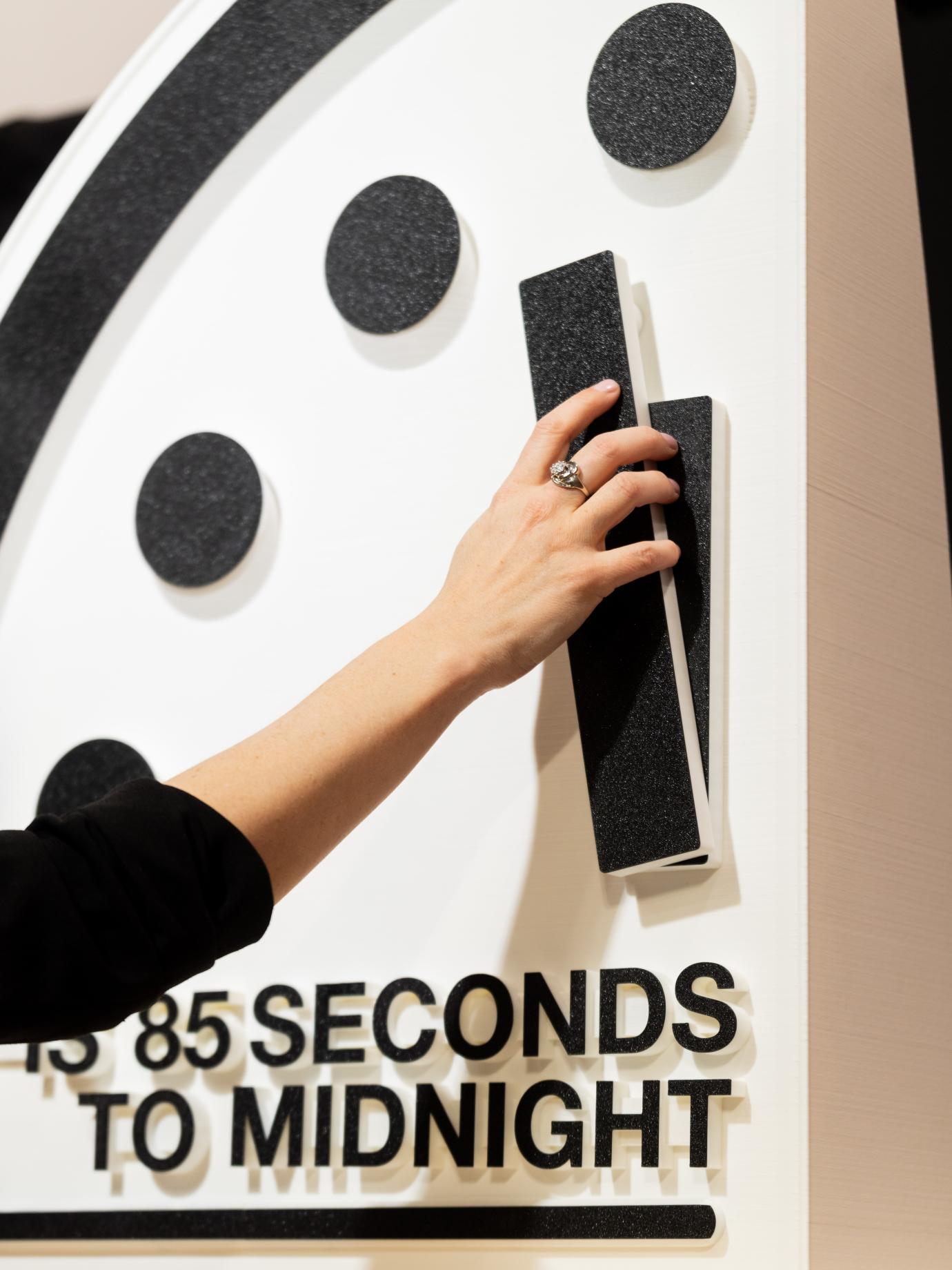
The Doomsday Clock was advanced to 85 seconds to midnight on Tuesday, January 27 — the closest humanity has ever come to global catastrophe in the clock’s 79-year history.

The Bulletin of the Atomic Scientists, which oversees the symbolic clock, pointed to a “perfect storm” of escalating global risks: the breakdown of nuclear arms control, accelerating climate disasters, and the unchecked expansion of artificial intelligence.

The new setting pushes the world four seconds closer to midnight than last year’s mark of 89 seconds.
Why the Clock Moved in 2026
Foremost among the Bulletin’s concerns is the collapse of international nuclear diplomacy. Scientists warned that the February 5 expiration of the New START Treaty between the United States and Russia will leave the world’s two largest nuclear arsenals without any legally binding limits for the first time in decades.
Climate change was another decisive factor.
The Bulletin noted that 2025 saw record-breaking global temperatures, along with severe heatwaves and flooding, while political efforts to reduce greenhouse gas emissions remained dangerously inadequate.
The group also sounded alarms over what it called an “information armageddon.” Advances in artificial intelligence have made large-scale disinformation cheaper, faster, and more effective, threatening democratic institutions and undermining international cooperation at a time when unity is most needed.
What Is the Doomsday Clock?
First introduced in 1947 by Manhattan Project scientists — including Albert Einstein and J. Robert Oppenheimer — the Doomsday Clock is a metaphor for how close humanity is to destroying civilisation through its own technologies.
Midnight represents total global catastrophe or human extinction.
The setting is updated annually by the Bulletin’s Science and Security Board, in consultation with a Board of Sponsors that includes eight Nobel laureates.
From Minutes to Seconds
When the clock debuted, it was set at seven minutes to midnight. Its position has shifted over the decades in response to geopolitical tensions and scientific risk. The safest moment came in 1991, when it was moved back to 17 minutes to midnight following the end of the Cold War and major arms-reduction treaties.
Since 2020, however, the Bulletin has abandoned minutes in favor of seconds, reflecting what it describes as a “new abnormal” — a period of sustained, overlapping existential threats.
The move to 85 seconds signals a belief that the window for meaningful global action is rapidly closing.
A Warning — Not a Prophecy
Despite its stark message, the Bulletin stresses that the Doomsday Clock is not a prediction of the future, but a warning.
“The Doomsday Clock is not a forecast,” said Alexandra Bell, President and CEO of the Bulletin. “It is a reflection of current reality. We can turn the hands back, but it will require a level of global cooperation and scientific leadership we have not seen in recent years.”
👉 Click here to read the latest Gujarat news on TheLiveAhmedabad.com