
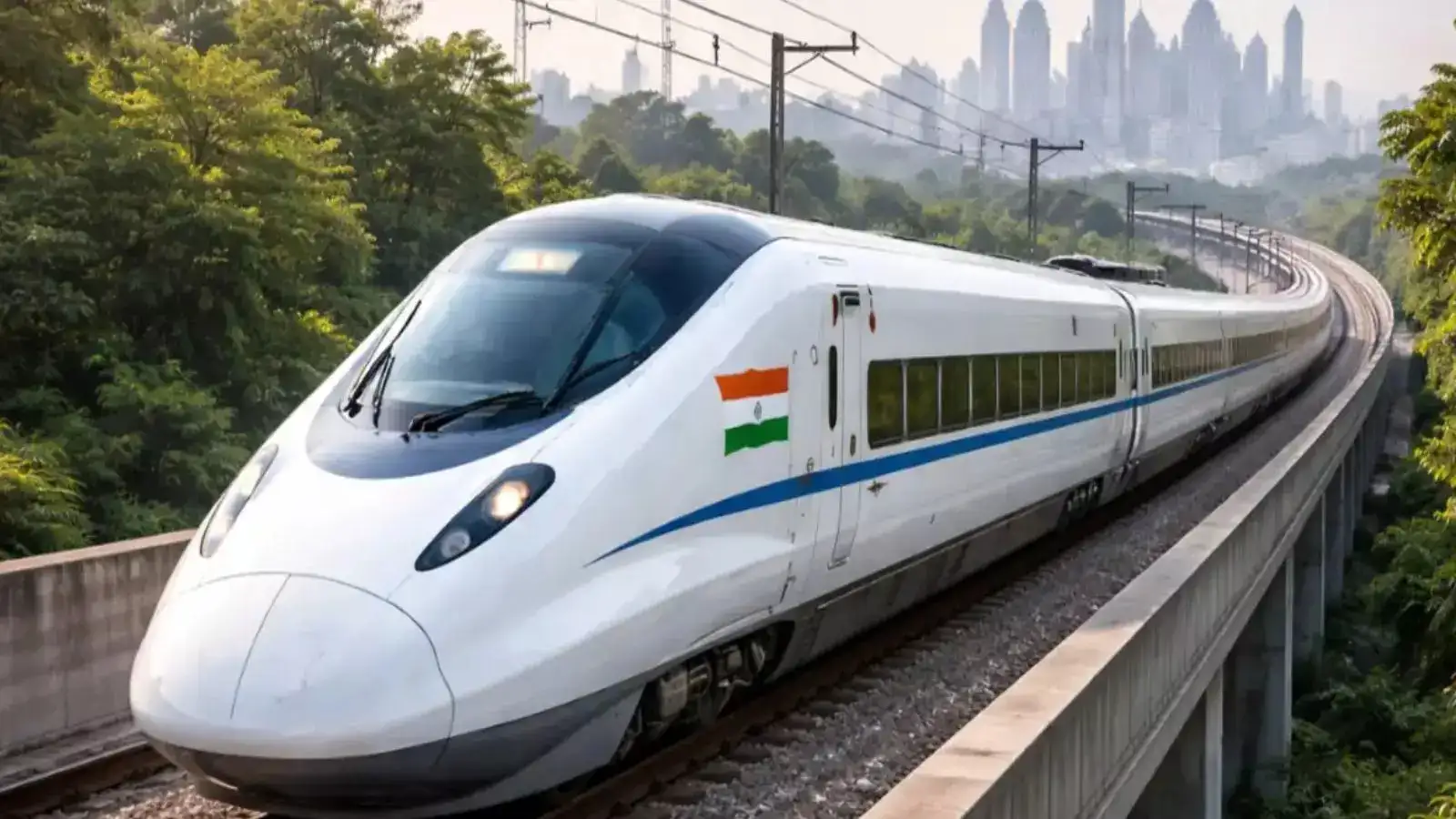
The Union Budget presented by Finance Minister Nirmala Sitharaman has sparked strong resentment in Maharashtra after the Nagpur–Mumbai high-speed rail corridor was completely left out, despite years of preparatory work, official assurances, and substantial public expenditure on surveys and planning.

While the Budget announced several new high-speed rail corridors—including Mumbai–Pune, Pune–Hyderabad, Hyderabad–Chennai, Chennai–Bengaluru, and Delhi–Varanasi—the conspicuous omission of the Nagpur–Mumbai corridor has raised uncomfortable questions among rail users, experts, and citizens. Critics are asking why a Detailed Project Report (DPR) was prepared at all if the project was never intended to move forward, and who will be accountable for the time and public funds already spent.

The exclusion is particularly puzzling given that groundwork for the Nagpur–Mumbai bullet train began as early as January 2021. Extensive surveys—including aerial LiDAR mapping, ridership analysis, and environmental and social impact assessments—were conducted over nearly ten months. These were comprehensive technical exercises designed to pave the way for Cabinet approval, not preliminary or symbolic studies.
Based on these surveys, the National High-Speed Rail Corporation Limited (NHSRCL) prepared a DPR and submitted it to the Railway Board. In early 2022, then Minister of State for Railways Raosaheb Danve stated publicly in Nagpur that the DPR would be finalised and forwarded to the Railway Ministry by March. He had also clarified that the corridor would largely run parallel to the Samruddhi Mahamarg, require only about 30 per cent land acquisition, and be mostly elevated—measures aimed at addressing farmers’ concerns and minimising displacement.
Senior NHSRCL officials had confirmed at the time that surveys were complete and the DPR was in its final stage. Had the process proceeded as indicated, the project could have secured approvals from the Railway Ministry and the Union Cabinet, leading to construction. Instead, the project appears to have quietly disappeared from policy priorities, without any official explanation.
The silence becomes more striking in light of the Budget’s aggressive push for high-speed rail corridors elsewhere in the country. For Nagpur, Vidarbha, and large parts of Maharashtra, the omission is being seen not merely as an oversight but as a policy snub, reinforcing long-standing perceptions of regional neglect.
The proposed Nagpur–Mumbai corridor was planned over a 741–766 km stretch, with stations at Nagpur, Wardha, Pulgaon, Jalna, Aurangabad, Shirdi, Nashik, Shahapur, and other locations. Designed for speeds of up to 350 kmph, the trains were expected to carry around 750 passengers and reduce travel time between Nagpur and Mumbai to just 3.5 hours—potentially transforming economic integration and regional growth.
According to the DPR, the estimated project cost was ₹232 crore per kilometre, comparable to other high-speed rail projects that have now received Budget support. Despite meeting technical, logistical, and strategic benchmarks, the Nagpur–Mumbai bullet train has effectively been shelved without transparency or public accountability.
As the Centre celebrates the launch of new corridors, Maharashtra—particularly Vidarbha—is left grappling with unanswered questions, broken assurances, and the unsettling possibility that years of planning have been reduced to little more than paperwork gathering dust.
👉 Click here to read the latest Gujarat news on TheLiveAhmedabad.com