
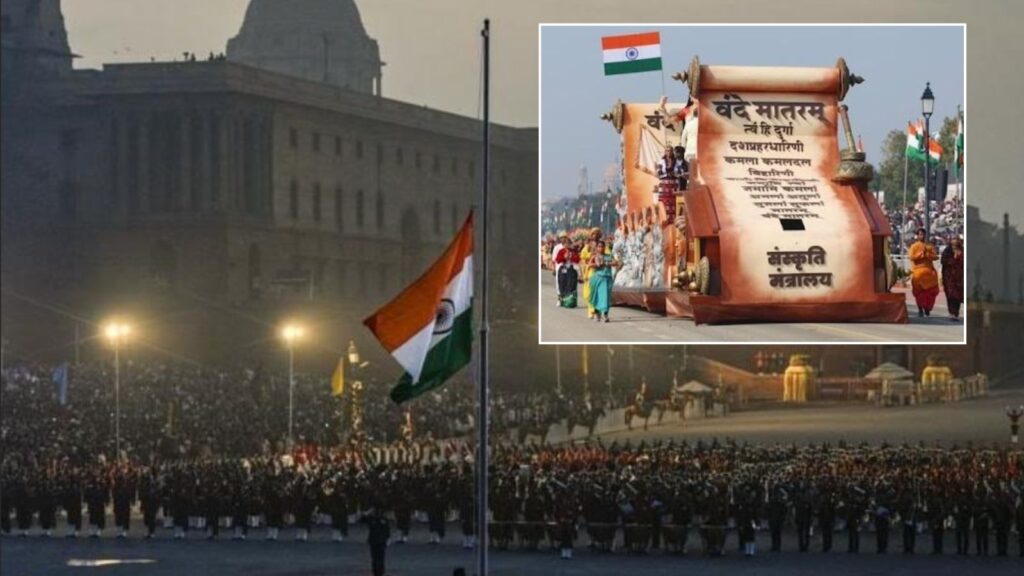
The Union Home Ministry has introduced a comprehensive new protocol for the rendition of ‘Vande Mataram’, mandating that the complete six-stanza version of India’s national song — including verses dropped by the Congress in 1937 — be performed at a wide range of official functions.
The directive, issued on January 28 and circulated to all states, Union territories and constitutional authorities, also requires audiences to stand to attention during its performance. It further stipulates that when ‘Vande Mataram’ and the national anthem ‘Jana Gana Mana’ are both played at an event, the national song must precede the anthem.
The move is likely to trigger political debate, especially in light of last year’s heated exchanges in Parliament over the truncated version of the song.
Clear protocol for the first time
Written by Bankim Chandra Chatterjee in the 1870s and closely associated with India’s freedom movement, ‘Vande Mataram’ has until now lacked an official framework governing its performance. In contrast, ‘Jana Gana Mana’ has long been subject to detailed guidelines.
Under the new rules, the full six-stanza version — lasting approximately 3 minutes and 10 seconds — must be played or sung at key state and ceremonial occasions. These include:
Civil investiture ceremonies
The arrival and departure of the President at official events
Immediately before and after the President’s addresses on All India Radio and national television
The arrival and departure of governors and lieutenant-governors at formal functions
Occasions when the national flag is brought on parade
When performed by a band, a roll of drums in a specified slow-march pattern must precede the song to alert the audience.
The ministry has stated that audiences must stand to attention whenever the official version is sung or played. However, it clarified that moviegoers are not required to stand if the song appears within newsreels or documentaries in cinemas, as doing so would disrupt the screening.
Mass participation and schools
The guidelines classify events into three categories:
Occasions where the national song must be played
Events where it must be played and sung with mass participation
Events where it may be sung
Mass singing will be mandatory during events such as flag unfurling ceremonies and other cultural or ceremonial programmes held outside parade settings. Authorities have been advised to arrange choirs, circulate lyrics and ensure proper audio systems to facilitate uniform participation.
Schools across the country have been directed to begin the day with community singing of ‘Vande Mataram’, alongside efforts to foster respect for the national song, the national anthem and the national flag.
The order also permits the song to be sung at non-ceremonial events attended by ministers or dignitaries, provided appropriate decorum and respect are maintained.
Potential political flashpoint
The requirement to include all six stanzas — four of which were omitted in 1937 — is expected to draw political reactions. The decision follows intense debate last year during a special parliamentary discussion marking 150 years of ‘Vande Mataram’.
Prime Minister Narendra Modi had accused the Congress of diluting the song’s legacy by excluding certain verses and claimed that former prime minister Jawaharlal Nehru aligned with Muhammad Ali Jinnah in opposing the full version, arguing it might offend sections of the Muslim community. “Vande Mataram was divided first, and then the country was divided,” Modi had said during the debate.
The government further highlighted the song during this year’s Republic Day celebrations, which adopted the theme “Swatantrata Ka Mantra — Vande Mataram.”
A major shift in practice
Since 1950, when ‘Vande Mataram’ was accorded the status of national song, only its first two stanzas have typically been performed at public events. The new directive makes the full six-stanza version the standard at formal state occasions.
According to the Home Ministry, the guidelines are intended to provide clarity on the proper performance of the national song, emphasising decorum and respect. The move represents the most extensive effort so far to formalise ‘Vande Mataram’’s role in official ceremonies and public life.

👉 Click here to read the latest Gujarat news on TheLiveAhmedabad.com