
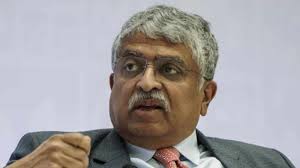
Infosys Chairman Nandan Nilekani has issued a strong warning about the future of the technology sector, stating that more than 90 million tech jobs worldwide are at risk due to the rapid advancement of Artificial Intelligence (AI). Speaking at the Infosys AI Investor Day 2026 in Bengaluru, Nilekani said the current AI revolution is transforming business operations in ways that surpass previous technological disruptions.

According to him, the large workforce hired for specific coding and support functions across India is increasingly vulnerable. He noted that the era of “writing code as a goal” is coming to an end, as AI systems are now capable of handling routine development tasks more efficiently. This shift is pushing the IT industry away from legacy systems and toward AI-native architectures, fundamentally restructuring talent demand.

170 Million New AI-Driven Roles Expected
Despite the projected displacement of 90 million jobs, Nilekani said the AI transition could generate at least 170 million new roles globally. He highlighted the growing importance of “agentic” systems and “non-deterministic” environments, where outcomes are shaped by complex and dynamic inputs.
Professionals previously focused on front-end development, quality assurance (QA), and IT support are being encouraged to upskill and transition into emerging AI-centric roles to stay competitive in the global economy.
Five Emerging AI Roles Reshaping the Industry
Market insights from LinkedIn and the Stanford AI Index Report 2025 indicate strong investment flows into five key AI-driven roles:
- AI Engineers: Responsible for building and scaling Large Language Models (LLMs) to optimise enterprise workflows.
- AI Forensic Analysts: Specialists who use machine learning to monitor LLMs for bias and examine digital evidence in cyber incidents.
- Forward-Deployed Engineers: Client-facing professionals who integrate customised AI solutions in sectors such as healthcare and banking.
- Agentic Workflow Architects: Designers of autonomous AI systems capable of managing end-to-end business processes like supply chain operations.
- Data Annotators: Experts tasked with cleaning and labelling data, increasingly requiring domain-specific knowledge in areas such as medicine and law.
India Emerges as a Global AI Talent Hub
The Stanford AI Index Report 2025 shows that India recorded a 33.4 per cent year-on-year increase in AI hiring — the highest globally. Additionally, AI skill penetration in India is 2.5 times higher than the global average.
This momentum is particularly evident in southern technology hubs such as Bengaluru and Hyderabad, which lead the country in AI-related job postings.
LinkedIn’s 2026 “Jobs on the Rise” report further supports this trend, ranking Prompt Engineer as India’s fastest-growing job, followed by AI Engineer and Manager of Artificial Intelligence. Companies are increasingly prioritising hybrid skill sets that combine AI expertise with human strengths like adaptability and complex problem-solving.
With nearly 70 per cent of corporate budgets now directed toward modernising legacy systems for AI readiness, demand for traditional tech roles continues to decline, while new AI-focused specialisations gain prominence.
👉 Click here to read the latest Gujarat news on TheLiveAhmedabad.com