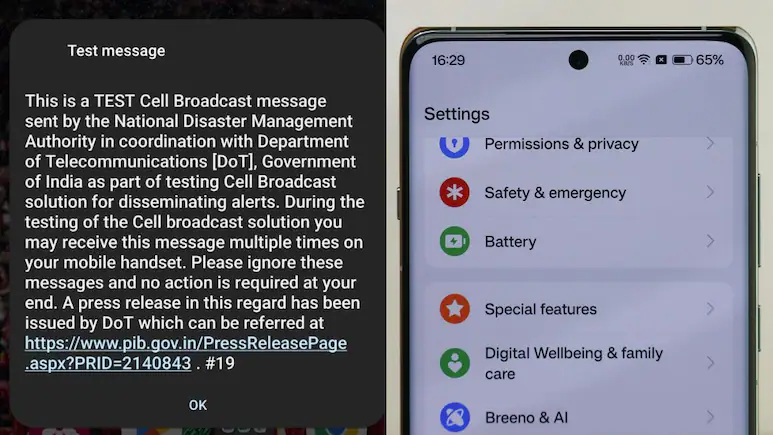
The National Disaster Management Authority (NDMA), on Friday (Feb 20) afternoon, in coordination with the Department of Telecommunications (DoT), carried out a live test of the government’s emergency alert system. The exercise involved sending a broadcast message to Android and iOS smartphones, which triggered loud beeps or vibrations as part of efforts to assess the new public safety mechanism.

The system, developed by the Centre for Development of Telematics (C-DOT), has been widely used by disaster management authorities to issue SMS alerts in various Indian languages during natural disasters, severe weather warnings, and cyclonic events.

“This is a TEST Cell Broadcast message sent by the National Disaster Management Authority in coordination with Department of Telecommunications [DOT], Government of India as part of testing Cell Broadcast solution for disseminating alerts,” read the alert message.
“During the testing of the Cell broadcast solution, you may receive this message multiple times on your mobile handset. Please ignore these messages and no action is required at your end,” it added.
Why Are the Test Messages Sent?
The primary purpose of the Cell Broadcast Alert System is to deliver real-time emergency alerts, enabling authorities to quickly share critical information and help save lives. The technology is intended to warn people about major threats such as earthquakes, floods, tsunamis, and other disasters.
The system is already operational across all 36 States and Union Territories (UTs) in India. It is used to send disaster- and emergency-related alerts via SMS to citizens located in specifically geo-targeted areas.
Unlike standard text messages, cell broadcast alerts are transmitted to all mobile phones within a defined geographic region at once. This ensures rapid and widespread coverage without overloading telecom networks.
👉 Click here to read the latest Gujarat news on TheLiveAhmedabad.com