
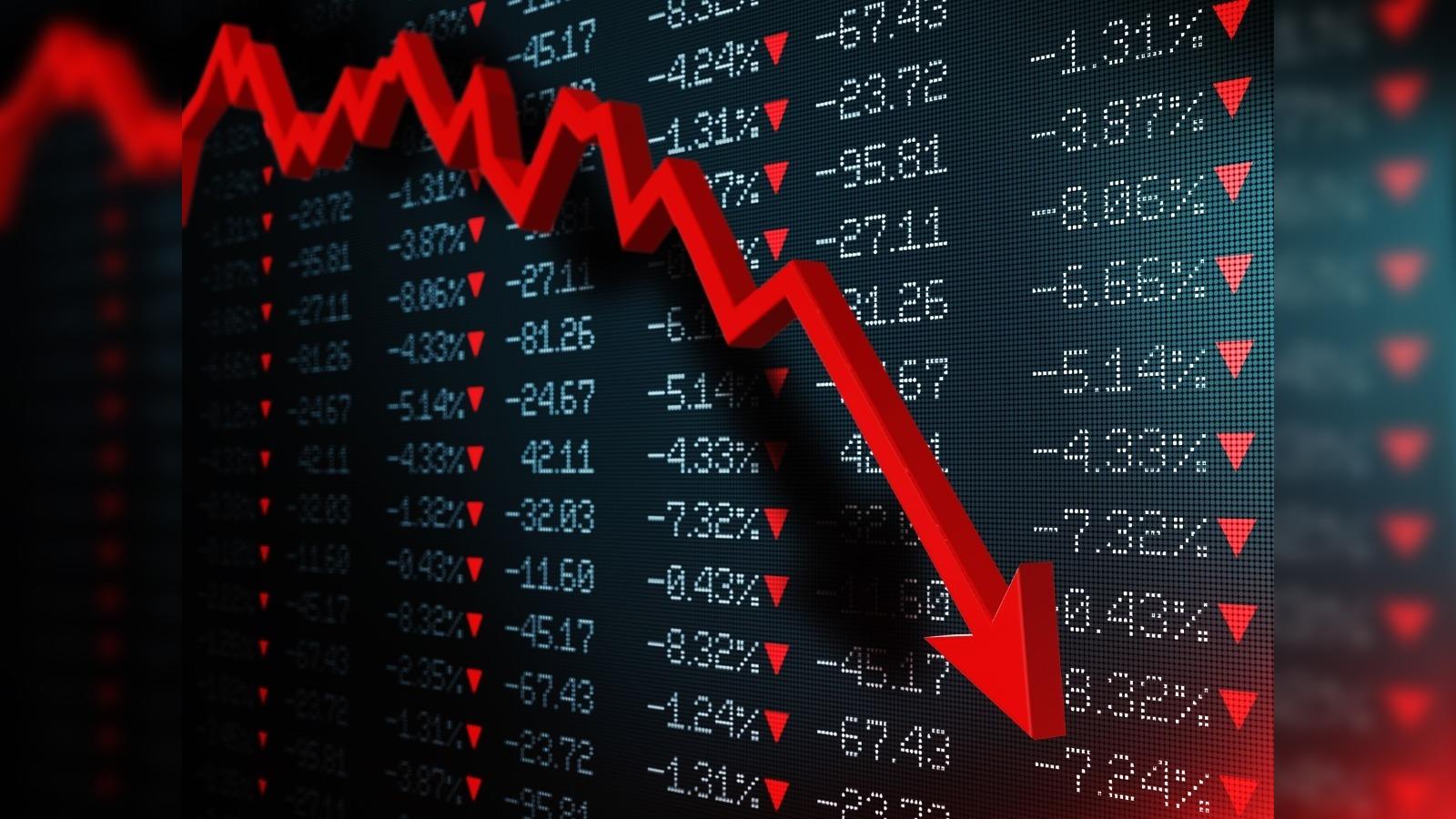
The Indian stock market witnessed sharp losses in intraday trade on Friday, March 27, with benchmark indices Sensex and Nifty 50 falling more than 1% each. The Sensex plunged nearly 1,200 points, or 1.6%, to hit an intraday low of 74,097, while the Nifty 50 declined over 350 points, or 1.5%, to touch 22,948. Mid- and small-cap indices on the BSE also dropped up to 2%.

Investor wealth eroded by around Rs. 7 lakh crore as the total market capitalisation of BSE-listed companies fell to Rs. 424 lakh crore from Rs. 431 lakh crore in the previous session.

Why is the stock market falling today?
Here are five key factors behind the selloff:
1. Weak global cues
Global market weakness is weighing on domestic sentiment. Major Asian indices such as Korea’s Kospi and Japan’s Nikkei declined up to 2%, following a similar fall in the S&P 500 and Nasdaq amid ongoing uncertainty over the war in West Asia.
2. Conflicting signals over the West Asian conflict
Mixed reports and uncertainty surrounding the West Asia conflict have kept investors cautious. While US President Donald Trump has indicated a delay in attacks on Iran’s energy infrastructure until April 6, reports suggest Israel plans to target Iran’s military-industrial base before the conflict concludes.
“If the war prolongs, crude remains elevated for months together, and gas availability constraints continue, the stress on India’s macros will be significant, and the market will discount that. In brief, everything boils down to how long the war will last,” VK Vijayakumar, Chief Investment Strategist, Geojit Investments, observed.
3. Rupee breaches the 94 per dollar mark
The Indian rupee weakened further, hitting 94.1575 against the US dollar, surpassing its previous record low of 93.98 earlier this week. Since the conflict began last month, the rupee has depreciated by about 3.5%, increasing the risk of foreign capital outflows.
4. Crude oil prices remain elevated
Brent crude surged to $108 per barrel amid uncertainty over the US-Israel-Iran tensions.
“The on and off reaction of the market to news and events regarding the war is likely to continue in the near-term. The spike in Brent crude back to around the $108 level will again trigger another round of risk-off in the Indian market,” Vijayakumar noted.
Analysts believe that a delayed correction in crude prices could slow India Inc.’s earnings recovery and weigh on market returns. Goldman Sachs has revised earnings growth projections downward to 8% and 13% for 2026 and 2027, respectively, from earlier estimates of 16% and 14%.
5. Foreign capital outflow
According to NSDL, foreign portfolio investors (FPIs) have withdrawn Rs. 1,23,688 crore from Indian markets in March up to the 25th, amid rising crude prices and rupee weakness linked to the US-Iran conflict.
Data also showed that FPI equity assets declined by $79 billion to $710 billion in the fortnight ended March 15—the steepest drop in at least six years, even exceeding the fall during the COVID-19 pandemic. In comparison, assets had fallen by $60 billion to $281 billion in the fortnight ended March 31, 2020, during global lockdowns.
👉 Click here to read the latest Gujarat news on TheLiveAhmedabad.com