
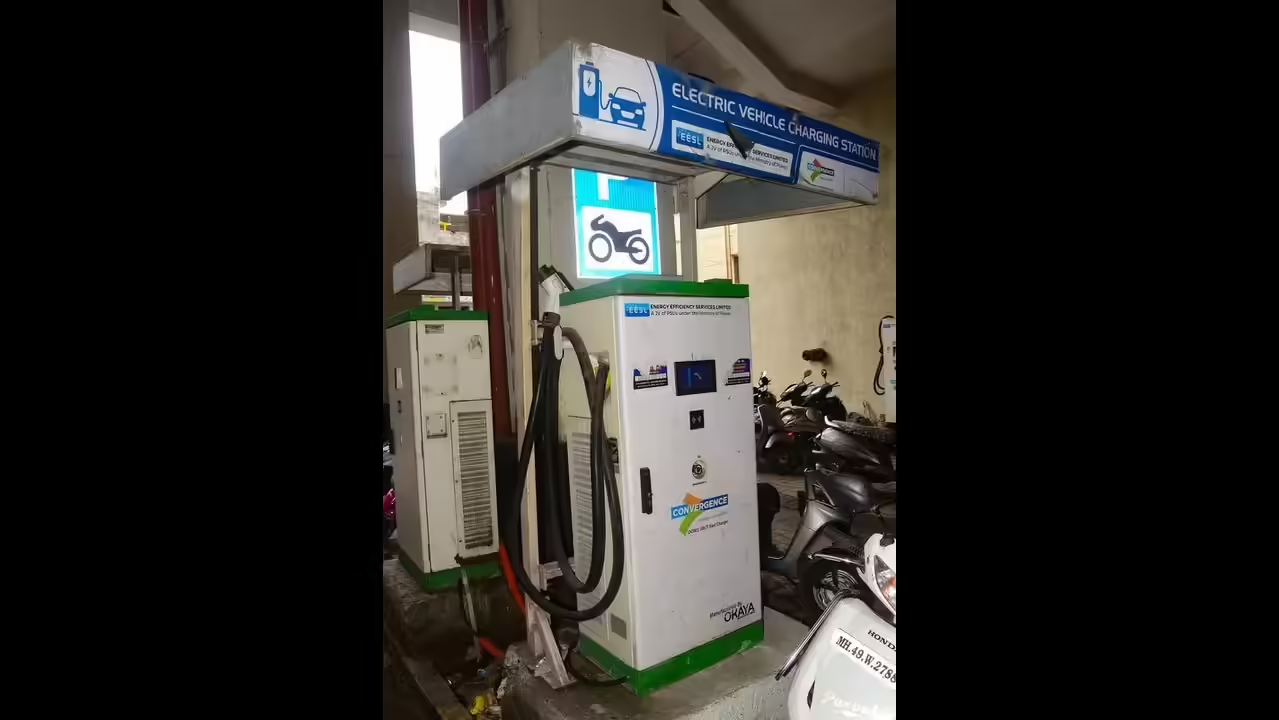
Around 40% of EV chargers, or nearly nine out of 24 stations managed by Nagpur Metro Rail Corporation Limited, were recently discovered to be non-working.

Nagpur Metro Rail Corporation Limited has ensured that every metro station in the city will have at least one functional Electric Vehicle (EV) charging facility within a week, as repair and upgrade work gathers pace across the network.

Recently, EV charging stations at nearly nine of NMRCL’s 24 stations were found to be non-functional, accounting for about 40% of the total. According to a senior MahaMetro official, the chargers installed in 2020 developed technical issues over time due to ageing technology, physical wear and tear, and maintenance gaps.
Currently, 15 out of 24 stations have operational chargers, while efforts are underway to restore the remaining nine. The EV charging infrastructure is owned and operated by Energy Efficiency Services Limited, a public sector undertaking under the Ministry of Power, Government of India. The system operates under a 10-year agreement signed with NMRCL in 2020, valid until 2030. NMRCL’s role is limited to providing space, with no responsibility for operational or maintenance costs.
Officials said the disruptions were caused by multiple factors, including cable damage due to rodents at stations near open drains, vandalism of display units, and accidental activation of emergency stop buttons, which require manual resetting. Additionally, earlier chargers designed for four-wheelers are now being upgraded to meet evolving requirements.
To address these issues, EESL has onboarded Statiq as a service partner to strengthen repair work and on-ground monitoring. A dedicated two-member team will be deployed across stations to ensure continuous supervision and quicker resolution of faults.
The official added that chargers at Airport Metro Station and Institution of Engineers Metro Station have already been upgraded to support two-wheelers and three-wheelers, along with four-wheelers, marking a shift towards more inclusive charging infrastructure. Under its standard model, EESL continues to bear all procurement, operation, and maintenance costs, while NMRCL facilitates infrastructure through space provision.
The ongoing upgrades are expected to boost Nagpur Metro’s EV ecosystem, aligning with Maharashtra’s Electric Vehicle Policy, which identifies Nagpur as one of six key urban centres targeted to electrify 40% of the State Transport fleet.
👉 Click here to read the latest Gujarat news on TheLiveAhmedabad.com