
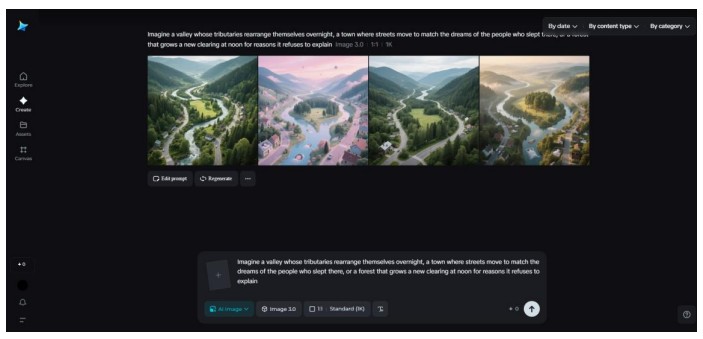
Some places ask you to bring a compass and a good pair of shoes, and then there are places that ask you to bring curiosity, patience, and a willingness to be pleasantly disoriented. Imagine a valley whose tributaries rearrange themselves overnight, a town where streets move to match the dreams of the people who slept there, or a forest that grows a new clearing at noon for reasons it refuses to explain. If you want a quick visual to hold while you imagine these shifting geographies, toss a few descriptive lines into Dreamina’s AI photo generator and let it conjure a mood plate: a map that breathes, cartography with moss, streets sketched in wet ink. After a quick generation by a smart AI generator, that image gives you something to pin your wandering thoughts to as you read.

This is speculative travel writing with practical luggage: tips for navigating mutable terrain, the etiquette of landscape-change, and a handful of small experiments you can try the next time you wander your own local park and wonder if the ground is listening.

How the world moves when maps are unreliable
In places that redraw themselves, change is the landscape’s native grammar rather than an inconvenience. A lane might unspool into a terrace of oranges at dawn and then tuck itself into a canal by dusk. The first thing you learn is to expect transience and to treat wayfinding as a social skill. Locals tell stories of the same alley appearing in different neighbourhoods, and the best travelers learn the expressive dialects of place: a cobblestone that glows faintly means the route will widen; fresh chalk on a wall signals a junction that will vanish by sunset.
Practical navigation is less about insisting on permanence than about listening for cues. Watch shadows, read plant behavior, and learn the timing of change. Some maps — the sort purchased from respectful cartographers — fold like paper but unfurl like lungs: they show not only where things are but when they might be.
Quick & easy: Generating high-quality visuals using Dreamina
Step 1: Write a descriptive text prompt
Go to Dreamina and enter a text prompt that describes a mutable single scene: precise about behavior and atmosphere. For instance: “A cobbled street that unspools into a floating orchard at noon, twilight light, wet ink lines on old paper, scattered lanterns; cinematic grain.” This encourages Dreamina to create a mood plate you can utilize as a visual reminder.
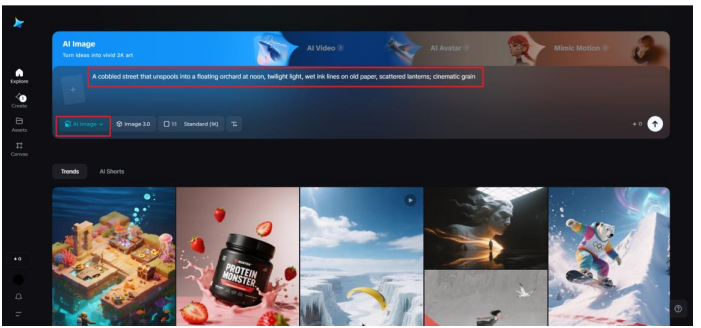
Step 2: Refine parameters and generate
Choose a model appropriate for texture and mood, select the aspect ratio that suits your planned purpose, select size, and 1k for quick drafts or 2k for a crisper print. Click Dreamina’s icon to create variations and select the one that best inspires your imagination.
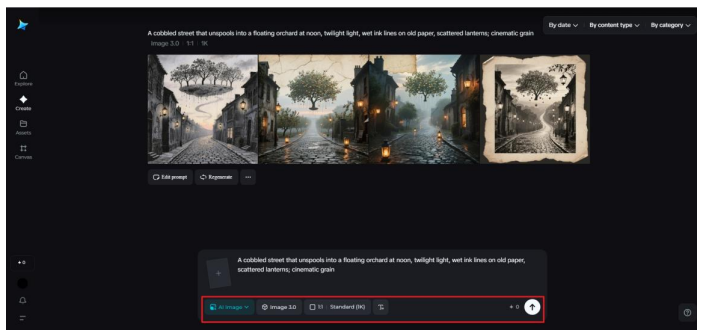
Step 3: Personalize and download
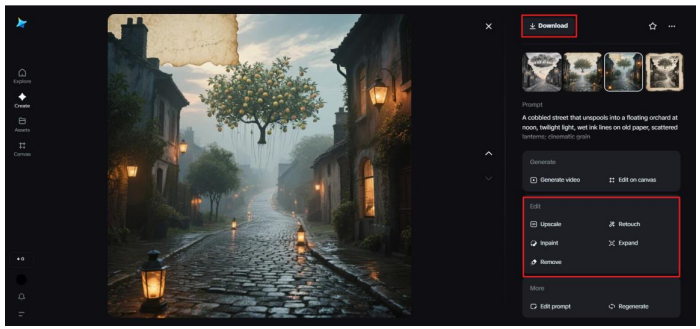
Apply Dreamina’s inpaint to sharpen individual details, zoom out to reveal more horizon or detail, eliminate distractions, and touch up color to your map palette. When the image is like the mutable scene you experienced, press the Download icon to file away a high-resolution plate for your field notebook.
Making a map you can trust
A trustworthy map in a shifting place is less a fixed object than a living practice. Carry a small stitched book where you paste map-cuts and write one-line notes: time, wind, a color you noticed at the edge. Over weeks the book becomes an atlas of mood and movement. Share copies with friendly locals and ask for marginal corrections. Maps made together hold more truth than those made alone.
If you want a tiny emblem to mark your personal map pages — a sigil that means “I was here” — a compact mark conceived with an AI logo generator can be helpful. A simple mark repeated in your margins knits fragments into a lineage.

Local etiquette when the land rearranges itself
There are rules that govern how humans and mutable landscapes coexist. First, never mark a new formation permanently — chalk, ribbon, or a polite pin is fine; nails and concrete are not. Second, ask the landscape’s permission before taking souvenirs; some clearings are tender and meant for regeneration, not for human pockets. Third, pay attention to communal rituals: communities often perform small gestures of thanks (leaving a spoonful of grain at the edge of a newly formed beach, for example) to acknowledge the land’s generosity.
Listening is key. If a route speaks — with a ripple of grass or a murmur from the stones —respond with quiet. The places that shift are often sensitive to insistence; they prefer to be invited rather than commanded.
Communities that steward shifting places
Where landscapes change frequently, social structures evolve to steward them. Neighborhood councils keep loose maps and hold rotating watch shifts for major nodes; caretakers remind visitors of local manners. The best communities teach newcomers simple phrases that help with negotiation: “May I step?” “Is this for dancing?” “Who grows the light here?” These phrases are more useful than a compass.
If you’re given a steward’s job for a day, honour it with humility: update communal notes, repair any rough markers gently, and pass on what you learned. Stewardship is a conversation across time.
Creative practice: making art from mutable routes
Mutable places are fertile for art. Photographers can make chronicles that show change through repeated frames. Poets write lines that shift like tides. If you want to make visual echoes of a mutable route, use Dreamina’s free AI art generator to create sequence studies — small pattern variations that riff on the same landscape motif — and then layer them into a long strip or a looping video. Such experiments help translate the land’s cadence into human media.
Artists and mapmakers sometimes collaborate to create “soft maps” — portraits of place that combine image, sound, and marginalia. These soft maps are legible in ways traditional maps are not: they say how a place feels, not only where it sits.
Safety and ethics of moving ground
Mutable landscapes raise practical ethics. Avoid leaving hazards in newly formed ways. Don’t exploit quick-change routes to smuggle goods, and be mindful that certain shifts hide sacred sites or are met with grief by locals when disturbed. When in doubt, ask. The best travelers are also the best listeners.
Bring basic medical supplies and know how to signal in the local etiquette if you need help. Mutable places are generous but not predictable; preparedness is an act of courtesy.
Parting thoughts on wandering well
When maps refuse to stay still, wandering becomes an art of relationship: you don’t conquer, you converse. These landscapes teach patience, curiosity, and a new kind of cartographic humility. They remind us that some of the most meaningful directions are the ones that arrive as surprises. Dreamina can help you capture the feeling of a mutable route and make a page for your field notebook that keeps the memory alive. Pack a light bag, learn the local phrases, and when the path shifts beneath your feet, don’t be afraid to smile — the land may be offering you a secret only it knows.
👉 Click here to read the latest Gujarat news on TheLiveAhmedabad.com