
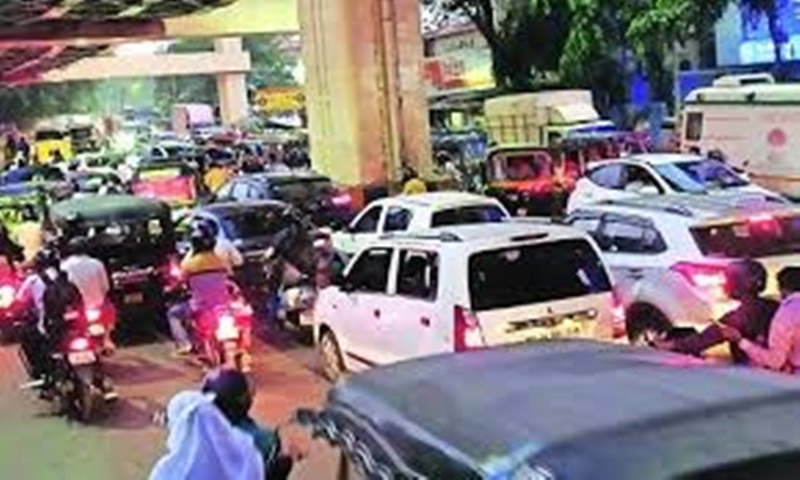
While Nagpur proudly showcases its Metro trains gliding overhead, the city below is struggling to breathe, caught in a near-crippling traffic crisis. The very agencies tasked with enforcing order—the municipal corporation and the police—have together allowed traffic management to descend into chaos. Increasingly, citizens are questioning whether traffic policing has been reduced to little more than towing vehicles and collecting fines, with no visible planning or meaningful enforcement.

The municipal corporation’s much-publicised parking plans remain largely confined to files, while conditions on the streets tell a far grimmer story. Roads have been steadily taken over by traders, footpaths encroached upon by defiant shopkeepers, and whatever space remains has been turned into a parking nightmare through sheer administrative indifference.

With a population of around 40 lakh, Nagpur today has more than 25 lakh vehicles on its roads—an alarming ratio in which machines now threaten to outnumber people. The city is burdened with nearly 16 lakh two-wheelers, 7 lakh four-wheelers, about 70,000 auto-rickshaws and over 50,000 e-rickshaws, creating suffocating conditions for both commuters and pedestrians.
Nagpur’s road network simply does not have the capacity to absorb this vehicular explosion. Yet while the RTO continues issuing licences and registrations, neither the civic body nor the police have answered a fundamental question: where are these vehicles supposed to be parked?
Footpaths across the city have effectively turned into “showrooms.” In areas such as Ramdaspeth, Dhantoli, Wardhaman Nagar and Gokulpeth, pedestrians are routinely forced onto busy roads, risking their lives amid parked two-wheelers, cars and encroaching merchandise. In the past year alone, 94,566 vehicles were penalised, yet traffic discipline remains elusive. Towing has become a farce—contractors lift vehicles, collect fines and move on, leaving the core problem untouched. Citizens allege increasing high-handedness, with vehicle owners bluntly told to “go to the police station and collect your vehicle,” even in areas where no legal parking exists.
The situation is worsened by unchecked street commerce. Though the city officially permits just 12 weekly markets, more than 52 illegal markets operate directly on main roads. Handcarts, vegetable vans and haphazard parking choke traffic so severely that even ambulances struggle to pass, aided by trader aggression and official silence.
Municipal records claim the existence of 25,571 metres of parking space, but reality tells another story. In commercial hubs such as Itwari, Gandhibagh, Mahal, Sitabuldi, Sadar, Medical Square, Nandanvan and Dharampeth, parking has become a daily flashpoint, often erupting into abuses, arguments and even physical altercations. Although the law mandates parking provisions in commercial buildings, many owners have illegally converted these spaces into shops, godowns or clinics.
Private hospitals, malls and commercial complexes benefit from this lax enforcement, while ordinary citizens are pushed onto the streets and penalised for no-parking violations. The civic body, after granting permissions, has largely looked the other way—leaving Nagpur’s traffic crisis to spiral unchecked.
👉 Click here to read the latest Gujarat news on TheLiveAhmedabad.com