
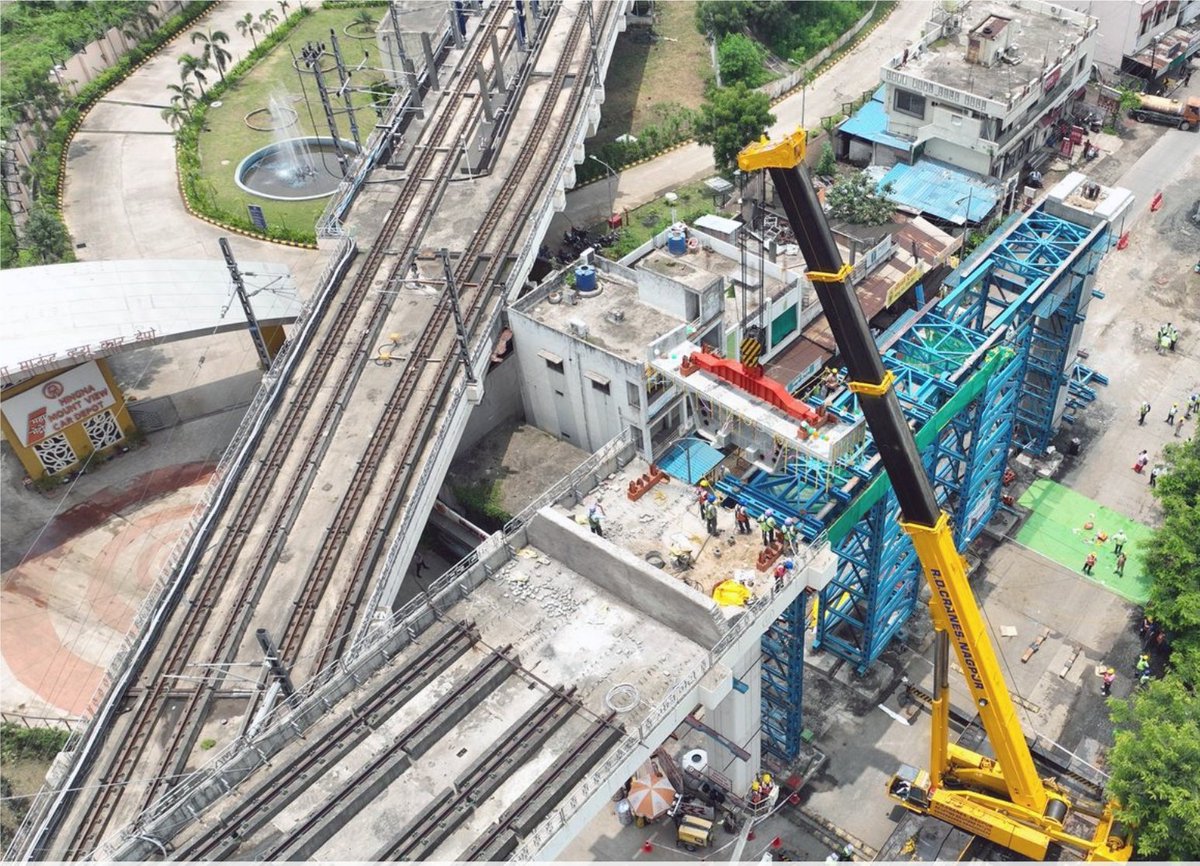
Stand beneath the Automotive Square–Kanhan Nagpur Metro corridor today and the scale of progress is unmistakable: 140 completed spans curve across the skyline, accounting for 31 per cent of the elevated guideway now physically in place above the city. Travel instead to Khapri–Butibori and the picture shifts sharply. There, just 24 spans have been completed out of a planned 610—barely 4 per cent of the intended viaduct. It is a seven-fold disparity in completion rates between two corridors of the same project, under the same November 2027 deadline and overseen by the same authority, MahaMetro.

A senior metro official outlined the broader status of construction, revealing that this divergence extends to the Aqua Line extensions as well. On the Lokmanya Nagar–Hingna stretch, 25 of 217 spans have been completed, translating to 11 per cent progress along the alignment. The Prajapati Nagar–Transport Nagar corridor has seen 17 of its 194 spans erected, or about 9 per cent completion. While neither matches the momentum of Automotive Square–Kanhan, both are significantly ahead of Khapri–Butibori.

Pier construction—the vertical columns that support the elevated guideway—presents a more balanced picture. Automotive Square–Kanhan has completed 66 per cent of its piers, compared with 27 per cent on Khapri–Butibori. Piers can be built simultaneously at multiple locations and largely independently of one another. They are essential groundwork, but on their own they do not bring trains any closer to running.
Span erection is different. It is the stage at which metro construction becomes unmistakably visible to the public—when a project shifts from excavations and concrete columns into the recognisable architecture of elevated transit. More critically, it is the phase that governs operational readiness. Track laying, electrical systems, signalling and other core elements all depend on completed spans.
Station construction adds another layer to this uneven progress. Of the 32 stations planned across Phase 2, work has begun at 28 sites. On Khapri–Butibori, foundations are underway at 9 of 10 stations; on Automotive Square–Kanhan, at 11 of 12. This indicates that station construction can advance independently of viaduct completion. Yet stations without connecting elevated guideways remain isolated assets—built, but not functional.
With November 2027 set as the official completion target for Phase 2, overall span progress stands at just 14 per cent, with corridor-wise completion ranging from 4 to 31 per cent. The question, increasingly, is not merely whether the deadline can be met, but whether all corridors can realistically reach it at the same time.
👉 Click here to read the latest Gujarat news on TheLiveAhmedabad.com