
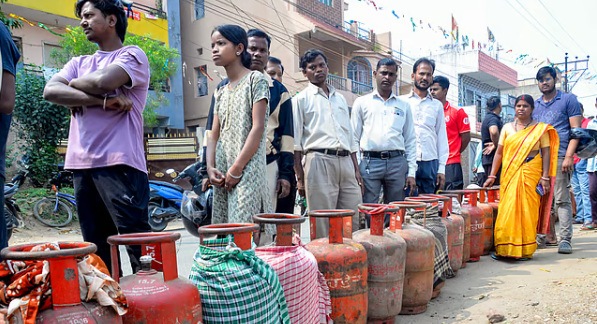
Escalating geopolitical tensions involving the United States, Israel and Iran are beginning to impact daily life in Nagpur, with the city witnessing a growing shortage and irregular supply of Liquefied Petroleum Gas (LPG). Disruptions in international maritime supply routes and rising fuel prices have started affecting local LPG availability, creating uncertainty for businesses and households.

What initially appeared to be a distant global conflict is now being felt on the ground, as gas agencies struggle to meet the sudden surge in demand. The situation has disrupted several sectors in the city, particularly the hospitality and food delivery ecosystem.

Restaurants and Food Vendors Hit Hard
The hospitality sector has emerged as one of the worst affected. From large restaurants to small roadside food vendors, many establishments are finding it difficult to procure commercial LPG cylinders required for daily cooking.
Several restaurant owners claim that booking helplines of distribution agencies have become unreachable due to the overwhelming demand for cylinders.
A café owner in the city said that when he tried to book a commercial cylinder on March 11, he was quoted around ₹3,400, almost double the standard price, indicating the emergence of a possible black market for LPG cylinders.
For small food cart operators whose livelihood depends on daily sales, the crisis has become even more challenging. With commercial cylinders unavailable or unaffordable, many vendors have begun using traditional wood-fired chullahs to continue operations. However, cooking on wood significantly slows down food preparation and also creates health concerns.
Slum Areas Turn to Coal and Firewood
In several low-income and slum settlements across Nagpur, residents have started stocking coal and firewood as an alternative for cooking.
Locals say the move is largely precautionary, driven by uncertainty about LPG availability and the lack of clear communication from gas distributors. Many families are turning to traditional fuels to ensure they have a backup for their daily cooking needs.
Clubs and Large Establishments Suspend Dining Services
The LPG supply uncertainty has also forced large establishments to scale back operations. One prominent club in Nagpur has reportedly closed its dine-in services from March 13, citing uncertainty in LPG supply required for large-scale cooking.
The decision highlights how even well-established institutions are struggling to maintain normal operations due to the supply disruption.
Food Delivery Sector Suffers Major Loss
The shortage has also triggered a domino effect on the gig economy. As several restaurants and cloud kitchens reduce operations or stop accepting orders due to lack of LPG, online food delivery platforms are witnessing a sharp drop in order volumes.
Delivery executives say their daily earnings have dropped nearly 50%, as the number of available orders has reduced significantly.
A delivery worker said that while he earlier completed 25 to 30 deliveries per day, the number has now dropped to around 10 orders daily, severely affecting his income. With delivery partners bearing their own fuel and vehicle maintenance expenses, the reduction in orders is making the work increasingly difficult.
Tiffin Services Also Affected
The crisis is also affecting tiffin service providers in the city who depend heavily on LPG cylinders for large-scale cooking.
Several operators have temporarily paused their services due to uncertainty in fuel availability. The disruption has particularly impacted students and working professionals living away from their hometowns, many of whom rely on these services for their daily meals.
Hotels Shift to Electric Cooking
Amid the crisis, the Nagpur Residential Hotels Association (NRHA) has advised hotels and restaurants to shift towards electric cooking appliances such as induction cooktops and electric fryers wherever possible.
Members have also been asked to limit or remove dishes that require high flame or long cooking durations in order to conserve limited fuel supplies and maintain basic operations.
According to a hotel association member, switching to electric appliances may slow down cooking but remains a better option than waiting indefinitely for cylinder deliveries.
Surge in Demand for Electric Appliances
Uncertainty surrounding LPG supply has also triggered a sharp rise in demand for electric cooking appliances in Nagpur.
Appliance retailers say that while they usually sell around 15 induction stoves in an entire month, the number has now jumped to **30–40 units per day over the past two days.
However, some shop owners say customers are also asking for unusual electric cooking gadgets after seeing misleading videos online, prompting retailers to advise buyers to purchase only reliable appliances from trusted brands.
Offices Consider Work From Home
The situation has also prompted some private offices in Nagpur to consider temporary work-from-home (WFH) arrangements as a precautionary measure.
Sources in a few firms say discussions are underway about allowing employees to work remotely for a short period if the situation worsens. However, such decisions will be taken only if there is a genuine shortage affecting daily operations.
Situation Being Closely Monitored
While the city has not yet faced a complete disruption in LPG supply, the ripple effects of global geopolitical tensions are already visible across multiple sectors in Nagpur. Businesses, households and delivery workers are now hoping that international supply chains stabilise soon so that LPG availability returns to normal.
👉 Click here to read the latest Gujarat news on TheLiveAhmedabad.com