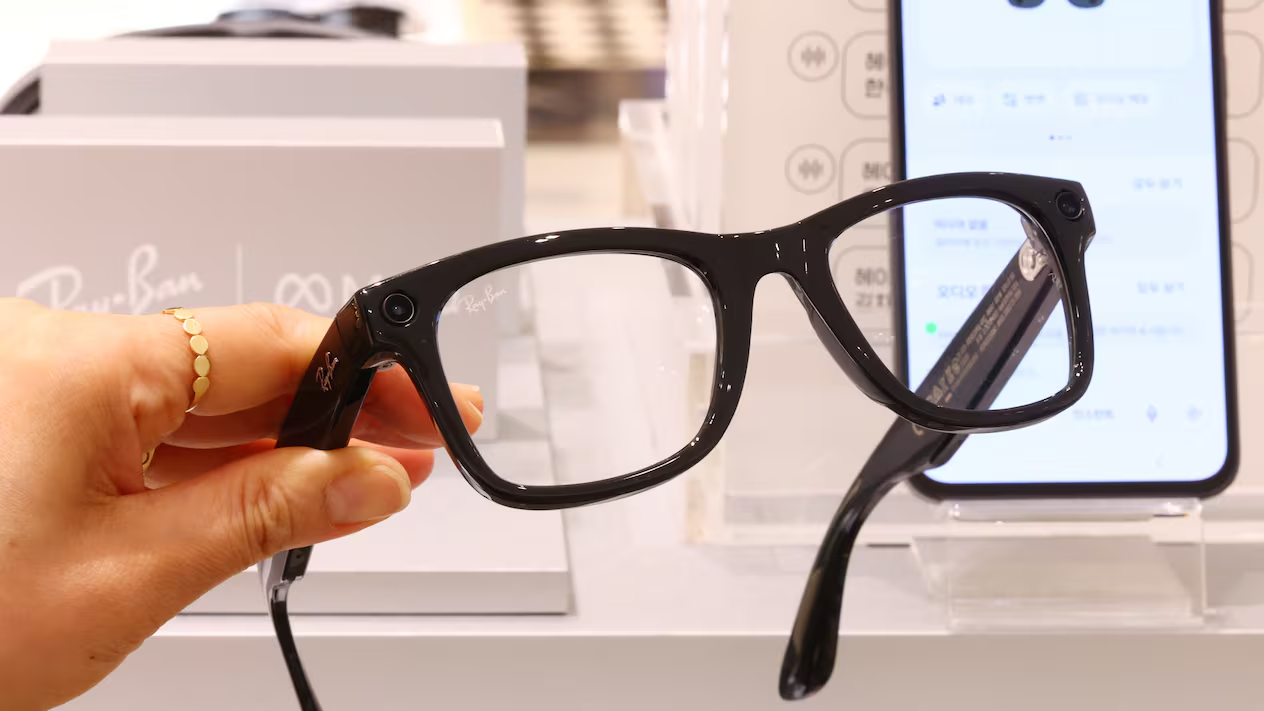
AI-powered smart glasses are emerging as a new cheating tool, enabling students to discreetly access answers during examinations. The trend has sparked concern across several East Asian countries, where competitive entrance and qualification exams play a crucial role in shaping academic and professional futures.

AI Glasses Used in Exam Cheating Cases
According to a CNN report, recent incidents have highlighted the misuse of AI-enabled eyewear. In South Korea, two candidates taking an English proficiency test were caught using smart glasses, marking the country’s first reported cases involving this technology.

In Taiwan, a medical school entrance exam candidate was also caught after invigilators noticed unusual eye movements. Officials later discovered the student’s smart glasses were generating heat, revealing the hidden device.
Authorities Tighten Exam Rules
In response, authorities have begun strengthening examination security measures. For China’s Gaokao—an intensely competitive national college entrance exam taken by more than 10 million students—candidates’ glasses are now being inspected before entering exam halls.
South Korea’s College Scholastic Ability Test (CSAT) agency is also working with the Education Ministry to explore additional safeguards, despite existing bans on electronic devices in exam centres.
In Taiwan, the university involved is reviewing its examination procedures to address risks posed by AI-enabled eyewear.
AI Glasses Are Becoming More Advanced and Harder to Detect
Experts warn that these incidents may be only the beginning. Modern AI glasses are increasingly lightweight, discreet, and capable of running advanced AI models while staying connected to smartphones or the internet. Their growing accessibility is further fueling concerns. Meta, for example, launched its AI-enabled Ray-Ban smart glasses in 2023, with more than seven million pairs reportedly sold last year.
“Wearable AI is as much a challenge to exams as ChatGPT was to essays in 2022, and I don’t think there is any reliable way to maintain traditional exam practices moving forward,” said Thomas Corbin, lecturer at Deakin University.
Research also underscores the concern. Assistant Professor Meng Zili of the Hong Kong University of Science and Technology (HKUST) tested commercially available smart glasses during a simulated undergraduate exam. The device was able to transmit questions to a large language model, which generated answers displayed directly on the lenses. The AI-assisted performance ranked among the top five in a class of over 100 students, significantly above the average score of 72.
After the experiment, Meng noted that the findings raise broader questions about how much memorisation should still be required in an AI-driven era.
Rethinking the Future of Exams
Experts say the rapid evolution of AI is forcing educators to rethink assessment methods.
Professor Zhang Jun of HKUST, who co-led the study, said education systems are struggling to keep pace with technological change, and must urgently reconsider how students are taught and evaluated.
Meanwhile, Kong Siu Cheung, Director of the AI and Digital Competence Education Centre at the Education University of Hong Kong, argued that AI should not be seen only as a threat. Instead, education systems should focus on building students’ critical thinking, reasoning, and metacognitive skills so they can use AI responsibly rather than become dependent on it.
👉 Click here to read the latest Gujarat news on TheLiveAhmedabad.com