
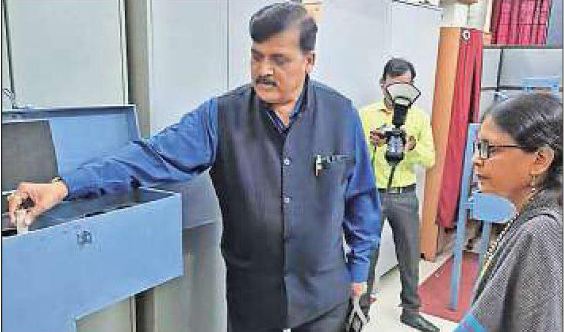
In a significant step towards tackling mercury pollution, researchers at Rashtrasant Tukadoji Maharaj Nagpur University (RTMNU) have developed what is claimed to be India’s first scientific system for the safe collection and disposal of discarded fluorescent tube lights and compact fluorescent lamps (CFLs). The innovation has been granted two patents.

The research was carried out by Dr Sanjay Dhoble, Head of the Department of Physics, along with research scholars Sanket Helode and Abhijeet Kadam. The project was funded by the university’s Department of Research and Extension.

While LED lighting has largely replaced conventional fluorescent lamps, millions of fluorescent tubes and CFLs containing mercury are still in use. Improper disposal of these lamps poses a serious environmental risk, as the toxic metal can contaminate soil, air and water when released. According to the research team, a fluorescent tube contains nearly 44 milligrams of mercury, while a CFL contains about 4 milligrams.
The patented technology comprises two complementary systems. The first is a specially designed collection unit that can be mounted on municipal waste collection vehicles, allowing used fluorescent tubes and CFLs to be collected from households without being damaged during transportation.
The second is a scientific disposal mechanism that processes broken lamps in a sealed chamber, preventing the release of mercury vapours. The mercury is then recovered through a chemical extraction process, making it suitable for reuse in industrial applications.
Dr Dhoble said India currently has no structured mechanism for the collection and scientific disposal of mercury-based lighting products. He noted that widespread adoption of the technology by urban local bodies could help minimise mercury pollution, improve waste management practices and reduce public health risks.
Congratulating the team on the achievement, RTMNU Vice-Chancellor Dr Manali Kshirsagar, Pro-Vice-Chancellor Dr Akhilesh Peshwe, Acting Registrar Dr Vijay Khandal and Director of Research and Extension Dr Dadasaheb Kokare said the innovation reflects the university’s growing contribution to environmentally sustainable research and technological development.
👉 Click here to read the latest Gujarat news on TheLiveAhmedabad.com