
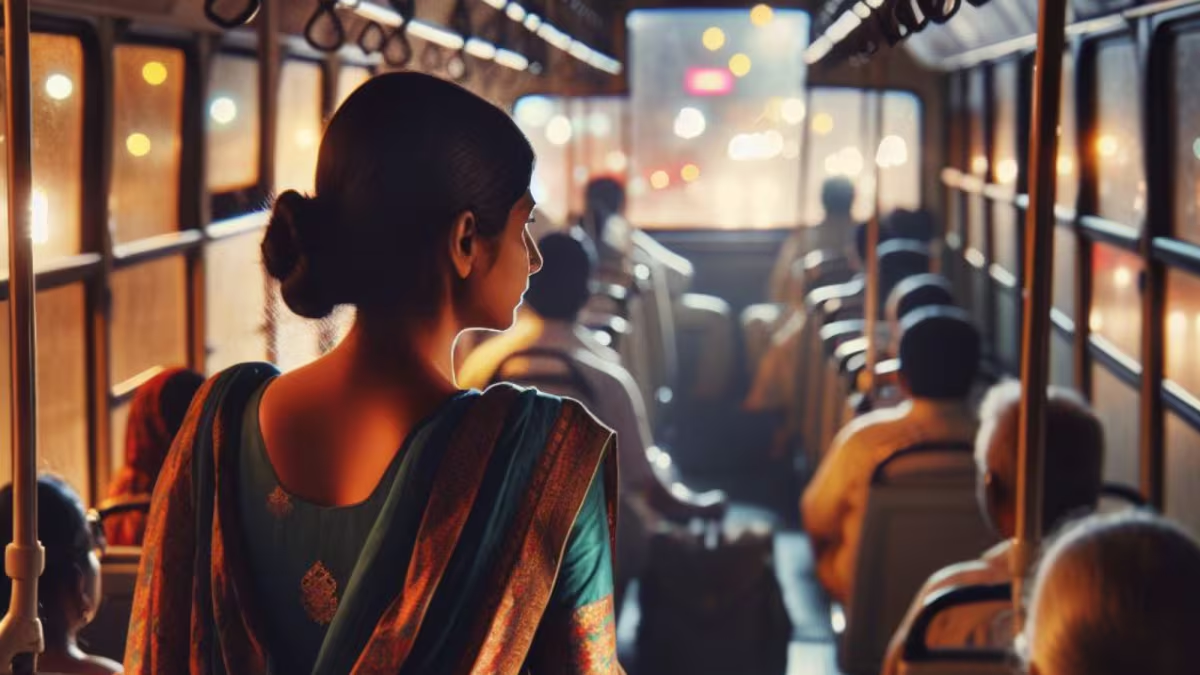
The National Annual Report & Index on Women’s Safety (NARI) 2025 offers fresh insights into the safety of Indian cities for women. Released on Thursday, the report surveyed 12,770 women across 31 cities, assigning a nationwide safety score of 65 per cent. Cities were ranked across categories ranging from “much above” to “much below” the benchmark, providing a clear overview of urban safety trends for women. The report was launched by Vijaya Rahatkar, chairperson of the National Commission for Women (NCW), who emphasized that safety is not merely a law-and-order issue but one that influences “every aspect of a woman’s life, including her education, health, work opportunities, and freedom of movement.”

What does the report say?
The survey found that 60 per cent of women feel “safe” in their city, while 40 per cent consider themselves “not so safe” or “unsafe.” This indicates that safety in Indian cities is inconsistent, with considerable gaps that demand immediate attention.

Safety plunges at night and in public transport
The report underlined a steep decline in the perception of safety after dark. Women reported feeling particularly vulnerable while using public transport and visiting recreational spaces at night. Educational institutions, on the other hand, scored relatively high with 86 per cent of women reporting they felt safe — especially during daylight hours. However, confidence dipped drastically once outside the campus or at night.
NARI 2025: List of safest cities for women
- Kohima
- Visakhapatnam
- Bhubaneswar
- Aizawl
- Gangtok
- Itanagar
- Mumbai
Workplaces safer, trust deficit in authorities
Workplaces emerged as comparatively safer spaces, with 91 per cent of women reporting a sense of security. Yet, nearly half of them admitted they were unaware whether their organisations had a Prevention of Sexual Harassment (POSH) policy in place. The NARI 2025 report revealed a concerning trust gap between women and authorities. Only one in four women said they trusted authorities to act effectively on safety complaints. While 69 per cent of respondents felt that current safety measures were “somewhat adequate”, more than 30 per cent flagged major gaps and failures in existing systems.
NARI 2025: Least safest cities for women
- Patna
- Jaipur
- Faridabad
- Delhi
- Kolkata
- Srinagar
- Ranchi
Harassment in public spaces underreported
The report found that 7 per cent of women experienced harassment in public spaces in 2024, with the figure rising to 14 per cent among those under 24. Neighborhoods (38 per cent) and public transport (29 per cent) emerged as the most common harassment hotspots. However, only one in three victims reported these incidents. The study emphasized that official crime statistics alone fail to capture women’s real experiences. “Two out of three women do not report harassment, meaning NCRB misses the bulk of incidents,” it noted, highlighting the need to combine crime data with perception-based surveys like NARI.
👉 Click here to read the latest Gujarat news on TheLiveAhmedabad.com