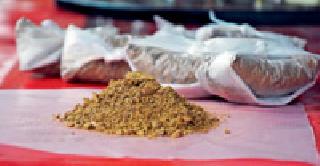
The seizure of 570 tonnes of substandard supari worth Rs 14 crore by the Food and Drug Administration (FDA) in Nagpur between April 1, 2025, and February 28, 2026, was initially projected as a major enforcement success. However, less than two weeks after the raids, a deeper ground investigation indicates that the crackdown may have exposed only a small part of a much larger and deeply rooted supply chain sustaining Nagpur’s widespread kharra trade.

The action raises a troubling question: how much unsafe supari has already entered the city’s consumption network—and where has it gone?

Seizures big, supply intact
Despite the large-scale crackdown, kharra continues to be easily available across Nagpur, sold openly in several areas with little apparent fear of enforcement.
Ground visits to multiple localities found vendors selling both loose and pre-mixed kharra without visible regulatory oversight. In many cases, the mixture is prepared on the spot, with tobacco, lime, and crushed supari blended in front of customers.
Officials admit that intercepting consignments rarely disrupts the retail supply chain. “We seize bulk shipments, but once the material enters local markets, tracking its movement becomes extremely difficult,” a senior FDA officer said.
The missing link in enforcement
The investigation highlights a key gap: the link between bulk supari trade and the city’s informal kharra mixing units.
Traders and insiders say a significant portion of seized or diverted stock often ends up in small, unregistered mixing units operating quietly across Nagpur. These units function outside formal monitoring, with no quality checks, testing, or standardisation—allowing substandard or contaminated supari to enter the food chain.
If even a fraction of the seized material had already been processed and sold before the raids, thousands may have unknowingly consumed unsafe products, raising serious public health concerns.
Inside Nagpur’s kharra economy
The term “kharra” comes from the grinding sound made during its preparation. Over time, it has evolved into a distinct local tobacco culture in Nagpur, with numerous variations.
A Sitabuldi resident said vendors typically offer 10 to 15 varieties, depending on ingredients and strength. Common variants include:
- Saoji tobacco kharra, known for its strong flavour
- Gavran kharra, made with locally sourced tobacco
- Branded tobacco kharra, using products like Gaichaap or Eagle
- Black kharra, with higher tobacco content
- White kharra, containing more lime
Prices remain highly affordable, ranging from Rs 20–30 for 20 grams to over Rs 100 for 100 grams, making it accessible to nearly all sections of society.
Hidden health risks
Public health experts warn that substandard supari may contain fungal toxins, pesticide residues, or chemical contaminants. When mixed with tobacco and lime, the combination can significantly increase the risk of oral cancer, gum disease, and other serious health issues.
Doctors caution that repeated exposure accelerates addiction and worsens long-term health outcomes—especially among younger users.
A ban mostly on paper
Although Maharashtra has banned gutkha and flavoured tobacco products, kharra has largely escaped regulation. Being locally prepared, unbranded, and distributed through informal networks, it falls outside the conventional enforcement framework applied to packaged tobacco.
The result is a decentralised and loosely regulated market where production and sales continue largely unchecked.
Profits over safety
Economics continues to drive the trade. Kharra is inexpensive to produce and highly profitable, particularly when lower-grade raw materials are used. Traders admit that in a competitive, unregulated market, cost often takes precedence over safety.
For small vendors and informal units, the business offers quick returns with minimal investment.
Rising youth consumption
One of the most concerning trends is increasing use among young people. With easy availability and no warning labels, kharra is often seen as a harmless local habit.
Vendors frequently operate near schools, colleges, and labour hubs, making the product easily accessible to students and daily wage workers. Health workers report a rise in early tobacco dependence among teenagers, indicating the habit is spreading quietly but rapidly.
Enforcement gaps remain
Despite large-scale seizures, last-mile monitoring remains weak. Local mixing units and street vendors largely operate outside systematic inspection.
Once raw supari enters city markets, there is no effective mechanism to track its distribution or consumption.
For Nagpur, this is no longer just a tobacco enforcement issue—it has evolved into a silent public health crisis unfolding in plain sight.
The recent FDA seizures may have revealed part of the problem. But the deeper network—linking bulk traders, informal processors, and thousands of retail sellers—suggests the full scale of the kharra trade remains far from uncovered.
👉 Click here to read the latest Gujarat news on TheLiveAhmedabad.com